
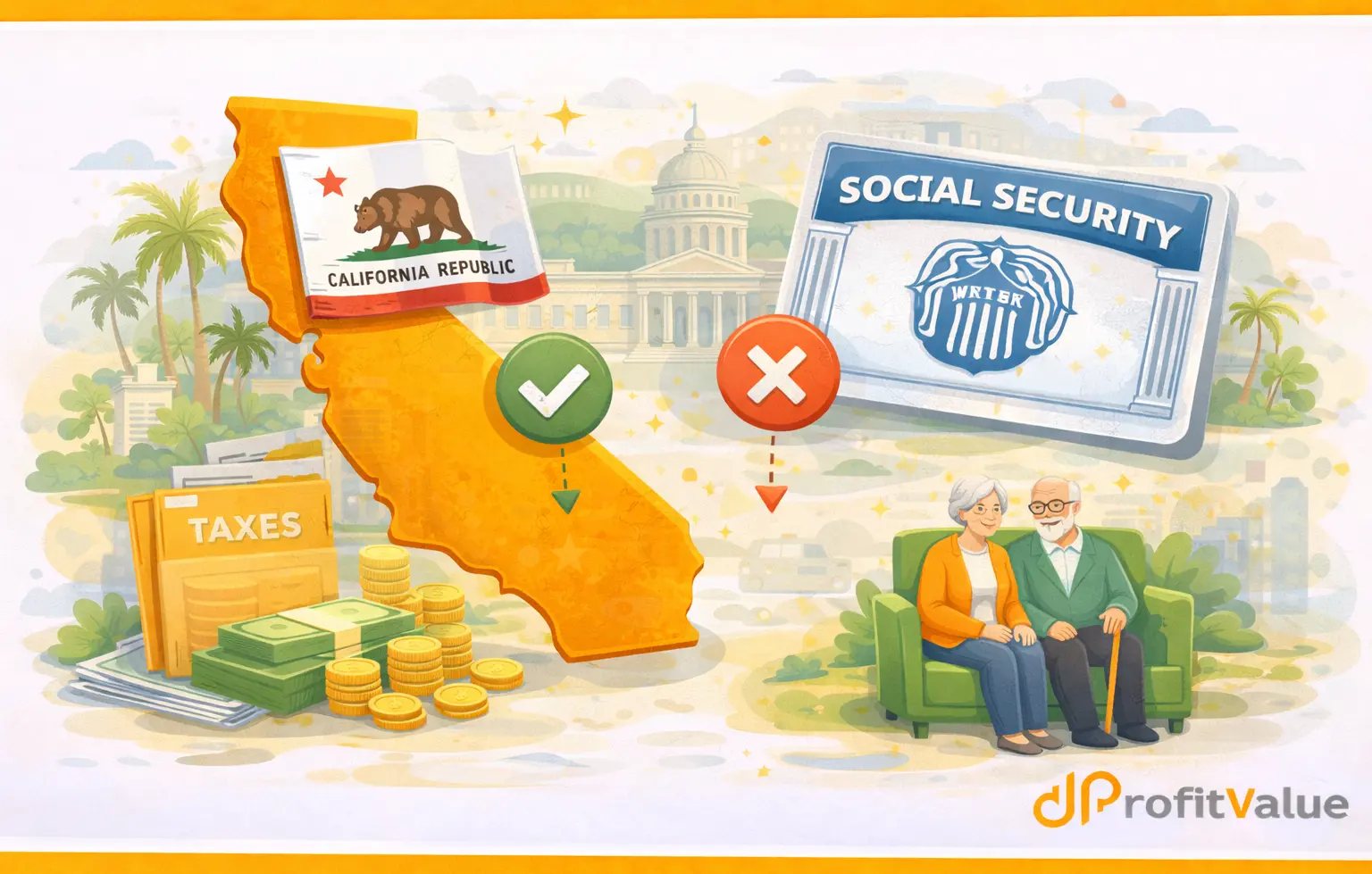
Did you know that around 15% of California’s population is retirees? In 2020, around 15% of the Californians were aged 65 or more, meaning retirement age. However, retiring itself isn’t easy nowadays. US provides social security benefits to retirees, but in some states the benefits themselves are taxable too. This brings the question does California tax social security?
The answer is no, California does not tax social security benefits at the federal level. However, Californians may still owe federal income taxes depending on their overall retirement income.
This article will explain if social security benefits are taxed in California, how federal taxes still apply and the strategies you can use to minimize the impact of tax liabilities.
Does California Tax Social Security? Taxes On Retirement Income

No, California doesn’t tax social security benefits at the state-level. Whether, you receive a small monthly check in the form of retirement benefits or a larger benefit, taxes on social security in California are not levied on retired individuals.
This rule applies to all Californians, regardless of their earnings or filing status. Unlike some states that partially tax social security, California fully exempts taxes on social security retirement benefits.
However, this doesn’t mean that you won’t pay a single penny in taxes in California. While the state doesn’t tax it, the federal government may still tax a portion of your benefits depending on your combined income. This confuses many retirees as they think they are being taxed twice.
To fully understand the federal tax rules, it is important to look beyond your state and consider how federal taxation works alongside California’s tax-friendly treatment of social security.
Why California does not tax social security?
As explained above, social security benefits in California are not counted in your taxable income. This rule is backed by California law, which excludes retirement benefits from state taxes. California Revenue and Taxation Code Section 17087 confirms that federal rules making benefits taxable do not apply for California tax purposes.
In simple terms:
- Your benefits are not counted when calculating state taxes
- Even high-income retirees receive this exemption
This makes California one of the more tax-friendly states for Social Security recipients. However, this doesn’t mean that you will not pay any taxes, whatsoever. It is important to understand that states and federal government apply their own laws separately. And, federal laws apply on all states.
Whereas, a state can have its own laws, and, may or may not choose to tax their residents. We will explain the difference between state and federal tax systems later in this section.
Does this apply to all retirees?
Yes, all California residents are exempted from social security taxes regardless of:
- Income level
- Filing status
- Benefit amount
Even if you owe federal taxes on your benefits, you will pay $0 in California state tax on that income.
After understanding if California taxes retirees, let’s understand the difference between federal and state taxes on social security.
Federal Vs State Taxes On Social Security
One of the biggest confusion in tax season is that the federal government and states use completely separate tax systems. This means that it is entirely possible to owe federal taxes, even if your state doesn’t tax social security benefits.
How the federal government taxes social security?
The federal government taxes social security based on the term “combined income”. It is a formula that helps determine how much, if any, of your benefits are taxable on your federal returns. This makes people think that they are being taxed twice. First, they pay payroll taxes like OASDI tax during their working years. Then, they pay income taxes in their retirement.
However, it is important to note that not all retirees are expected to pay taxes on benefits that they receive. Learn more about it in our guide on taxes on retirement benefits.
According to IRS rules, whether you pay federal income tax on Social Security depends on:
- Your filing status, and
- Your total combined income for the year.
The IRS explains that to calculate the taxable portion, you must compare:
- One‑half of your Social Security benefits, plus
- All your other income, including taxable pensions, wages, interest, and
- Tax‑exempt interest from certain investments, such as municipal bonds.
These numbers are added together to create your combined income (sometimes also called provisional income).
This calculation is described in detail in IRS Publication 915, which is the official federal guidance on social security and railroad retirement benefits.
Federal tax thresholds
The IRS applies a tiered threshold system based on combined income, portion of benefits taxable and filing status.
| Filing Status | Combined Income Threshold | Portion of Benefits Taxable |
|---|---|---|
| Single or Head of Household | ≤ $25,000 | 0% |
| Single or Head of Household | $25,001–$34,000 | Up to 50% |
| Single or Head of Household | > $34,000 | Up to 85% |
| Married Filing Jointly | ≤ $32,000 | 0% |
| Married Filing Jointly | $32,001–$44,000 | Up to 50% |
| Married Filing Jointly | > $44,000 | Up to 85% |
| Married Filing Separately (lived with spouse) | Any amount | Up to 85% |
These thresholds were set by Congress and haven’t been adjusted for inflation for many years. This means that more retirees fall into taxable ranges today than when the rules were first created.
What benefits are included in federal taxation?
According to the IRS:
- Retirement benefits are potentially taxable depending on your combined income.
- Survivor benefits are treated the same way.
- Disability benefits may also be taxable.
However, Social Security Income (SSI) is excluded from federal taxes. Each year, you receive a Form SSA‑1099 from the Social Security Administration showing the total benefits you received, which is used when filing your federal tax return.
How federal and state taxes interact?
As explained above, federal government and state government make their own rules for taxes. Federal government taxes social security benefits using the metric combined income. However, it is important to note that they are income tax, and, not taxes on retirement benefits. If your income from these benefits exceed certain thresholds, only then, you will be required to file taxes.
Similarly, a state government may or may not tax social security. For example, states like California and Michigan don’t levy taxes on the benefits received. However, some states do tax social security benefits. So, in that case, you could be expected to pay both state and federal-level taxes, but they are independent tax systems.
Why this matters for retirement planning?
Understanding the difference between federal and state taxes helps you estimate your overall tax burden on total income. Knowing how much taxes you need to pay in retirement can help avoid surprises in tax season. Although, California doesn’t tax social security, other forms of retirement income may still be taxable depending on your financial situation. Let’s explore this in detail.
Other Types Of Taxable Retirement Income In California
Although, California exempts social security benefits from income taxes, most other types of retirement income may still be taxed as ordinary income in California. The state uses your federal Adjusted Gross Income (AGI) as the main factor. And, then, the state government applies its own income tax rates to determine your tax owed to the state.
California follows progressive tax system which means, that the more you earn, the higher tax bracket is applied to your income. For the year 2026, tax rates vary from 1% to 13.3% depending on your income level. Here are the main types of fully taxable retirement income in California.
1. Pension income
Pension income, whether you receive from an employer or a government pension plan is a taxable income source in California. These include:
- Employer-sponsored defined benefit plans
- Federal or military pensions
- Public employee pensions (unless specifically exempted)
For Californians, all or most of the pensions payments will typically be taxed as ordinary income since benefits were originally funded with pre-tax dollars. The taxable portion reported federally (on Form 1099-R) becomes part of your taxable income in California as well.
Example
Suppose, you receive $50,000 anually in retirement funds. This income is added to your federal AGI. Your total income taxable in State of California will include this amount. From there, the state taxes are calculated using California’s own tax rates (e.g., upto 13.3%).
2. Traditional IRAs and 401(k) distributions
Withdrawals from traditional IRAs, 401(k), 403(b), 457 plans, and similar tax-deferred retirement accounts are taxed as ordinary income in California. Since, contributions to these accounts were typically made using pre-tax dollars, California (like the IRS) treats them as ordinary state income tax.
- Traditional IRA distributions are fully taxable.
- Similarly, 401(k), 403(b) and 457 plans are fully taxable as well.
Your taxable amount is usually reported on Form 1099‑R, which you use to calculate both federal and state tax.
Example
Let’s say you withdraw $30,000 from a traditional IRA in 2026. This amount is treated as taxable income on both your federal returns and state returns. California then applies its own tax rates to this amount.
3. Annuity payments
Annuities that are part of retirement planning (not including Social Security or certain qualified public retirement plans) are generally considered taxable in California to the extent that they represent taxable distributions from the contract. Payments received from the employer or personal annuity plans are taxed like ordinary income.
Example
If you receive $15,000 per year from an annuity plan, then this amount will be treated as taxable income both federally and at the state-level. Your local tax rates then apply to this amount to calculate the taxes owed.
Investment income and other retirement earnings
Other types of earnings in retirement that are taxable in California include:
- Interest income (e.g., from banks or bonds)
- Dividends
- Capital gains tax from the sale of investments or due to property taxes
- Rental income collected from your properties
These incomes are included in your federal AGI and then taxed by California according to standard tax tables.
Example
Suppose, you have $10,000 in taxable interest and $5,000 in capital gains, then both amounts are counted in your AGI. Your taxable income for California becomes $15,000. Then, your state tax is calculated using the combined total.
5. How California’s tax rates apply?
California follows progressive income tax rates, meaning the more you earn, the higher taxes owed. Here are the tax rates set by California according to 2026 data.
| Taxable Income Range | Tax Rates |
| $0-$11,079 | 1% |
| $11,080-$26,,264 | 2% |
| $26,265-$41,452 | 4% |
| $41,453-$57,542 | 6% |
| $57,543-$72,724 | 8% |
| $72,725-$371,479 | 9.3% |
| $371,480-$445,771 | 10.3% |
| $445,772-$742,953 | 11.3% |
| $742,954+ | 13.3% |
These are the tax rates set by California based on the most recent data available. California retirees are expected to pay state-taxes only if their source of income is other than social security benefits. Keep in mind, federal government still taxes your social security benefits, so, it is recommended to consult with a tax professional for better financial management.
How state and federal taxes apply together?
In order to manage your sources of retirement income effectively, it is important to understand how both state and federal taxes apply to your income.
Let’s suppose you earn $50,000 in retirement by any means other than social security. According to tax rates set by IRS for 2026, say your estimated federal tax is:
- ~$1,240 (10% portion)
- ~$4,500 (12% portion)
$5,700. And, using your local tax rates, your California retirement taxes are ~$2,500-$3,000 at an effective rate of 4-6%. Then, total amount paid in taxes is $8,500.
Keep in mind, that this is just an example. It is recommended to account for deductions, credits and other local or non-local factors for more accurate and advanced tax planning.
6. Special Notes
- Qualified Roth distributions: If you have a Roth IRA or Roth 401(k) and meet the IRS rules (e.g., account open 5+ years and age 59½+), then retirement account withdrawals are not taxable federally or by California.
- Public pension exemptions: Some California public retirement systems (like CalPERS/CalSTRS) may offer specific exemptions for certain types of public pension income, but most pension distributions are taxable.
- Early withdrawal penalties: California may impose additional state penalties (e.g., 2.5% on early distributions) separate from federal penalties.
After understanding the different types of retirement income sources California does tax except social security, let’s explore some strategies to minimize the tax impact for effective retirement planning in California.
Strategies To Minimize Retirement Taxes For Californians
Even though California doesn’t tax social security, other forms of retirement income such as pensions and annuities are treated as taxable income by the state. Fortunately, there a few legal strategies you can use to minimize your tax burden. Keep in mind, that you can’t completely eliminate taxes.
You will still be required to pay some amount to either your state or the federal government or both. But using these strategies can help lower tax impact on retirees.
1. Use tax-free retirement accounts (Roth IRAs)
Withdrawls from qualified Roth IRAs and 401(ks) are generally not taxed by the federal government and California, if the account meets the IRS requirements (account held for at least five years and owner must be 59.5 years of age or older). California treats Roth distributions the same way as federal government for tax purposes. This makes Roth IRAs one of the best ways for retirees to reduce their tax liabilities.
Example
Suppose you withdraw $20,000 regularly from a Roth IRA in retirement, that amount will not be counted in your California taxable income, helping you stay lower your tax brackets.
2. Manage the timing of retirement withdrawls
Because most forms of retirement income in California is taxable, timing your withdrawls can be a very important factor for reducing your tax burden. If you plan withdrawals in years when your total income is lower, your state tax rate will likely be lower as well.
Example
- Taking large distributions in one year could push you into a higher tax bracket.
- Spreading small withdrawals over multiple years often results in a lower overall tax liability.
This strategy also applies to federal taxable income; coordinating withdrawals to avoid spiking income can reduce your federal tax on Social Security benefits.
3. Delay Social Security benefits to reduce federal tax
Although, California doesn’t tax social security, the federal government may tax up to 50 or 85% of your benefits depending on your combined income. Delaying Social Security can reduce your total combined income in early retirement years, which may help keep more of your benefits from being taxed federally.
The Social Security Administration (SSA) offers information on claiming strategies and delayed retirement credits. Delaying benefits does not directly reduce California state taxes, but it can reduce federal taxable income, which indirectly improves total tax efficiency.
4. Take advantage of deductions and credits to lower income tax
Although, other types of retirement income are taxed in California, standard or itemized deductions on your state tax return can allow you to lower your tax bill at the state-level.
Example
- California’s standard deduction for 2026 is $5,202 for single filers and $10,404 for married filing jointly (subject to change each year).
- Itemized deductions such as mortgage interest, property taxes, and medical expenses (above federal limits) can also reduce taxable income.
5. Consider partial Roth conversions
If you have traditional pre‑tax retirement accounts (like a traditional IRA or 401(k)), consider doing partial Roth conversions in years with lower income. This means paying federal tax now to convert funds into a Roth account, so future withdrawals are tax‑free. Because California does not tax Social Security, reducing your federal taxable income in retirement can indirectly reduce the total amount of federal tax you pay on benefits.
However, this strategy must be evaluated carefully, as Roth conversions themselves incur federal tax in the year of conversion.
6. Plan taxable income to reduce taxable income
Interest income, dividends, and capital gains are all taxable in California at ordinary income tax rates. Being strategic about when you realize gains or interest can improve tax efficiency:
- Holding investments in tax‑advantaged accounts (IRAs, Roth accounts, 401(k) reduces annual taxable income.
- Harvesting investment losses to offset gains can reduce your taxable income federally and for state purposes.
7. Monitor AGI to protect your federal benefits
IRS bases the federal taxability of your social security using combined income (which includes half of your benefits and all other earnings). Therefore, it is recommended to lower your federal AGI through deductions, strategic withdrawls, and Roth planning to reduce your social security taxes. Keep in mind, that this doesn’t affect California’s state taxes on other income sources.
Conclusion
This article has explained thoroughly if the State of California taxes social security along with strategies to minimize the impact of income taxes. While, California’s tax rules exempts social security from state-level taxes, federal taxes may still apply to your benefits.
Moreover, if your retirement income comes from sources other than social security, your income will be taxed as ordinary income at both state and federal-level. Therefore, using the strategies mentioned above, you can not only lower your taxes, but also plan your retirement income strategy effectively. Do you have any questions? Let us know in the comments.
FAQs
Does California tax Social Security benefits?
No, the State of California does not tax Social Security benefits at the state level.
Do I still pay federal taxes on Social Security in California?
Yes. The federal government may tax up to 50% or 85% of your benefits depending on your income.
What retirement income is taxable in California?
Pensions, IRA/401(k) withdrawals, annuities, interest, dividends, and capital gains are generally taxable in California.
Are Roth IRA withdrawals taxed in California?
No. Qualified Roth IRA withdrawals are not taxed by California or the federal government.
Why do I pay taxes if California doesn’t tax Social Security?
Because federal tax rules are separate and may still apply based on your total income.