
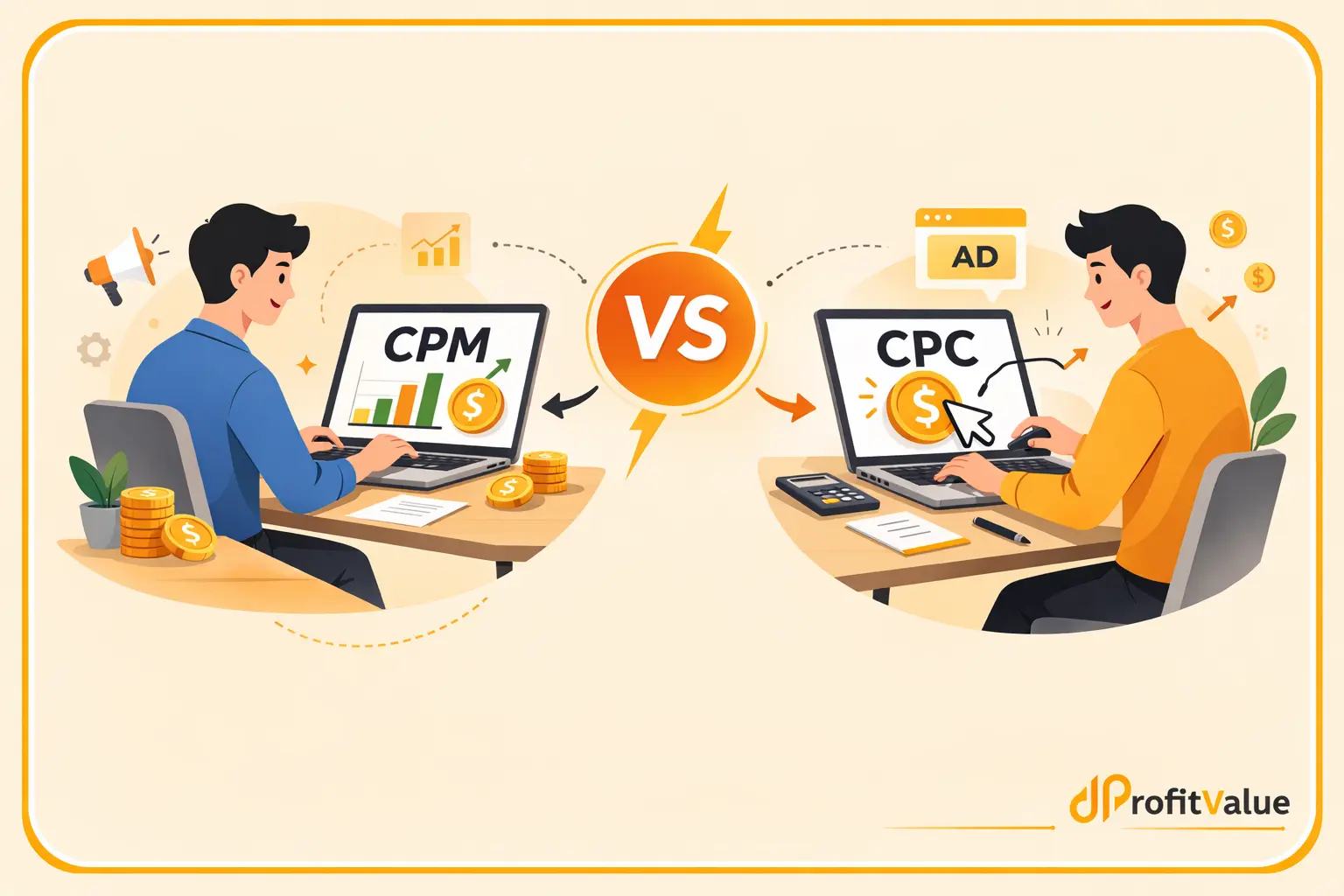
Do you run a website or a YouTube? Then you might have heard about earning money through ad revenue. Ads are one of the most popular ways bloggers and YouTubers earn money online. And, generally two kinds of advertising strategies CPM and CPC are considered by small business owners. Comparing CPM vs CPC and understanding their difference is crucial for maximizing your online revenue.
This article will break down the difference between cpc and cpm models to explain which works best for business owners, freelancers, bloggers and YouTubers in 2026.
What Is CPM? Overview On CPM Advertising

CPM stands for Cost per Mille. In this ad campaign, advertiser pays a fixed amount to the business owner for every thousand impressions on their ad. This fixed amount varies according to location, cpm companies and your niche. Unlike CPC advertising model, this campaign focuses on ad visibility.
How does it work?
The platform keeps track of how often visitors see your ad when you run online advertising campaigns. For instance, the advertiser pays the business owner $5 for each thousand impressions if the website has a $5 CPM rate. The business owner makes more money if more people view the ad.
Why CPM is Popular
CPM advertising is popular because the advertiser is able to improve their brand awareness through ad impressions. Publishers and creators can also earn from CPM since it relies on ad visibility rather than user action.
Example
Imagine you have a blog that gets 100,000 monthly visitors. If your ad network offers a CPM of $5, your potential monthly earnings from one ad could be calculated as:
Revenue = (Total impressions / 1,000) x CPM rate = (100,000 / 1,000) x 5 = $500
This shows how CPM allows website owners and content creators to earn a steady income if they have consistent traffic.
After understanding what is cpm, let’s explore the concept of cpc.
What Is CPC? Overview On CPC Ad Campaign
CPC stands for cost per click. As apparent by its name, it is a pricing model where advertisers pay a fixed amount to the business owner when a visitor clicks on their ad. Unlike CPM ad model, cpc campaign focuses on conversions and user engagement. This makes it a performance-based model, ideal for advertisers who want measurable results, such as website visits, app installs, or product purchases.
How does it work?
The advertiser pays a fixed amount to the website,, YouTube channel or app owner every time a visitor clicks their ad.. For instance, if the CPC rate is $1 and around 100 people click the ad, then the visitor would be charged $100 depending on the exact analytics.
Why CPC is popular?
CPC model is popular among other marketing campaigns primarily because it focuses more on clickthrough rate (ctr) rather than just ad visibility. This makes it more cost effective for ad campaigns who want conversions rather than ad impressions. Publishers and creators also benefit because high-quality content can encourage clicks, boosting revenue per visitor.
Example
Imagine you are a blog owner with 10,000 monthly visitors. If 2% of your visitors click on your CPC ads given that the CPC rate is $1:
Revenue = Number of clicks x CPC rate = (10,000 x 0.02) x 1 = $200
This shows that CPC model relies on user engagement rather ad visiblity.
After understanding what cpc means for ad campaigns, let’s see which of these model is better for online businesses and advertisers.
CPM vs CPC: Which Pricing Model Is Better?
CPM and CPC are both beneficial in their own way as they are suited for ad campaign goals. Understanding the difference between them is important to maximize revenue for website owners, YouTubers and business owners from ad campaigns.
| Feature | CPM (Cost Per Mille) | CPC (Cost Per Click) |
|---|---|---|
| Payment | Advertisers pay per 1,000 ad impressions | Advertisers pay per click |
| Focus | Brand visibility and awareness | User engagement and conversions |
| Risk for Advertisers | Paying for views even if users don’t click | Only pay for actual clicks, so lower risk |
| Risk for Publishers | Revenue depends on traffic volume | You generate revenue when someone clicks on your ad |
| Ideal For | High-traffic websites, display campaigns, brand promotion | Blogs, e-commerce sites, or campaigns with strong calls-to-action |
Which one is better?
The table above compares CPM and CPC pricing models. Now let’s decide which one is better and why.
- CPM is better if you want to increase brand awareness and you already have a high-traffic platform. It is ideal as you earn ad revenue for impressions. So, even if users don’t click the ad, you still generate money. Businesses can also choose this model as it improves your brand reach.
- CPC is better if you want conversions and direct measurable results such as clicks, purchases or sign ups. This model is ideal for blogs, YouTube videos, or any content that can generate clicks effectively.
CPM is better when you just want awareness and ad views. Whereas, CPC is better for encouraging users to take a specific action. This could be telling them to sign up, get started, order now etc. So, it is important to have clear advertising goals in order to pick the best option that aligns with your preferences and needs. We have an additional example here to understand their difference.
Imagine you run a blog with 50,000 monthly visitors:
- Using CPM at $2 per 1,000 impressions:
50,000 / 1,000 x $2 = $100
- Using CPC at $0.50 per click with a 1% CTR (500 clicks):
500 x $0.50 = $250
In this case, CPC earns more money since your visitors are actively engaging with the ads. However if your CTR is low, CPM might provide more consistent earnings.
Note: If you earn taxable income through CPM or CPC advertising, it’s important to understand how your average tax rate affects your overall profits.
Now, we will also look for some alternative options to see which other option could be better than these two.
Alternatives To Consider
If you are a business owner and you think that both CPM and CPC aren’t ideal for your digital advertising campaigns, then here are some alternatives for you to consider.
CPA
CPA stands for cost per acquisition or cost per action. It is an ad campaign that focuses on the completion of a specific action by a user. This could mean a form submission, a sign up, purchases etc. CPA again is action-oriented campaign used in landing pages for websites. It is best for businesses that sell a specific service or a product.
CPL
CPL stands for cost per lead. It is another performance driven pricing model used in advertising industry for capturing leads. Generating leads basically means gathering general user information (name, phone number, email addresses etc). In this case, advertisers usually pay when someone fills out a contact form.
CPV
CPV stands for cost per view. This paid advertising model is similar to cost per mille except the difference is more about the numbers and the platform. In CPM pricing model, advertisers are charged when every 1000 visitors view an ad. This model is usually used for banner ads, display ads and awareness campaigns.
On the other hand, CPV model is usually used on YouTube for displaying video ads in the content. The advertiser pays the content creator per view. The difference here is the number and the platform. In CPM model, you need 1000 impressions and the platform is usually a website, an app or a social media platform (Facebook, TikTok). But CPV model usually relies on YouTube content and video ads.
Conclusion
This article has explained the difference between CPM and CPC with their alternatives. Both pricing models have their strengths and weaknesses. CPM is usually used by content creators for generating passive income. Whereas, CPC and other relevant action-oriented ad placement campaigns are usually used by business owners who sell a specific product or service and want conversions or user engagement.
Sometimes, both business owners and content creators use both of these models simultaneously for maximizing their online revenue. Understanding these ad pricing strategies allows you to make informed decisions and optimize your ad revenue in 2026 and beyond. Whether you want consistent income from impressions or higher returns from clicks, choosing the right model or a mix of both can make a significant difference for your online business.
Do you have any questions? Let us know in the comments below.
FAQs
Is CPC or CPM better?
It depends on your goal. CPM is better for high-traffic platforms focused on brand awareness, while CPC works better if your audience actively clicks on ads. The right choice depends on traffic quality and engagement.
Is CPC the same as CPM?
No. CPM pays for 1,000 impressions, while CPC pays per click. CPM focuses on visibility, whereas CPC focuses on engagement.
Does YouTube pay CPM?
Yes. YouTube primarily uses a CPM-based system, meaning advertisers pay per 1,000 ad impressions. However, creators are typically paid based on RPM (revenue per 1,000 views) after YouTube takes its share.
What is a good CPM rate?
A good CPM depends on your niche, audience location, and platform. For example, finance and business niches often have higher CPMs compared to entertainment or gaming content.
Can you use both CPM and CPC together?
Yes. Many ad networks use a mix of CPM and CPC ads. This allows publishers to earn from both impressions and clicks, maximizing total revenue.