
Ad revenue is one of the most popular ways for content creators to earn online in 2026. Almost every other blogger or YouTube content creator out there generates money by a certain number of ad impressions. So, if you are an aspiring content creator who want to earn online, you might have heard about the term CPM rate. CPM is often compared with CPC (Cost per Click), so it is important to understand the difference to decide which model to use. Basically, CPM is the main metric related to ad revenue. But, exactly what is it? How does it work? And, what is a good CPM rate?
Some YouTubers earn $2 per 1000 impressions whereas others can earn about $30 for the same views. Why is the rate different for the same number of views? The truth is, that the average payout rate varies on your niche, location, ad format and traffic quality.
This article will explore what is a good CPM, exactly how does it work for different niches, platforms and locations and how to maximize your earnings online in 2026.
What is CPM? Understanding the CPM metric for ad revenue
There are several ways to earn online by displaying ads. And, one of the most common ways is CPM short for Cost per Mille. CPM is an ad campaign where an advertiser pays a fixed amount to the content creator for every 1000 impressions on their ad. Unlike CPC, CPM earnings directly depend on the number of impressions rather than the people clicking the ads. CPM model isn’t tied to click-through rate (CTR). Instead it relies on brand awareness and ad visibility.
This metric is influenced by several factors such as your content niche, traffic quality, location and ad format. It is important for content creators to understand this metric for maximizing their online earnings. A high payout rate means a fairly low number of impressions can be quite profitable. Conversely, lower rate means higher ad views are requried to earn the same amount. Let’s understand how to calculate it.
How is CPM calculated?
The image above shows how CPM is calculated by dividing the total cost with the number of impressions and then multiplying it with 1000. Using this formula, you can calculate your potential earnings based on your ad impressions and adjust your content strategy accordingly. After understanding the CPM formula, let’s see what is a good CPM.
What is a good CPM? Breaking down the average CPM rate in 2026
The table above shows that CPM rates vary across different niches in 2026. Industries such as finance, insurance, and loans command significantly higher CPM rates compared to gaming or entertainment.
It’s worth noting that “good CPM” is relative to your niche. For example, a $7 CPM rate might be considered good in a niche like gaming and entertainment, but below average for finance and insurance sector. Additionally, the CPM metric alone doesn’t determine your earnings.
For example, if a creator has a monthly traffic of 500,000 with a $5 CPM, then he might end up making more revenue than someone who earns $25 CPM for 20,000 impressions. So, the key factor here is audience size as well along with your niche.
Instead of focusing only on chasing high-paying niches, creators should aim to balance niche selection, audience targeting, and traffic growth. Niche is one of the factor that affects your payout rate. But it isn’t the only one. Factors like the platform you are using for monetization are also critical for your average CPM rate.
Different platforms attract different types of advertisers, use different ad formats, and operate under different revenue-sharing models. As a result, CPM rates on YouTube can differ greatly from those on Google AdSense or social media platforms.
Let’s take a closer look at how these rates vary across major platforms in 2026.
CPM rates by platform in 2026
While niche determines advertiser demand, the platform determines how the ads are priced, delivered and shared with creators. Each platform has its own advertiser ecosystem, audience behavior, and revenue-sharing model which directly impacts these rates. Here are different CPM rates for different platforms.
YouTube CPM in 2026
When it comes to advertisement, then video ads remain one of the most popular options for marketing teams out there. That’s where YouTube comes in. It is one of the most popular platforms for CPM-based monetization. However, many publishers and content creators misunderstand how YouTube payout system really works. On YouTube, adverstisers bid for ad placement and the platform charges them a certain CPM (cost per thousand impressions). A certain percentage of this amount is shared with the creator.
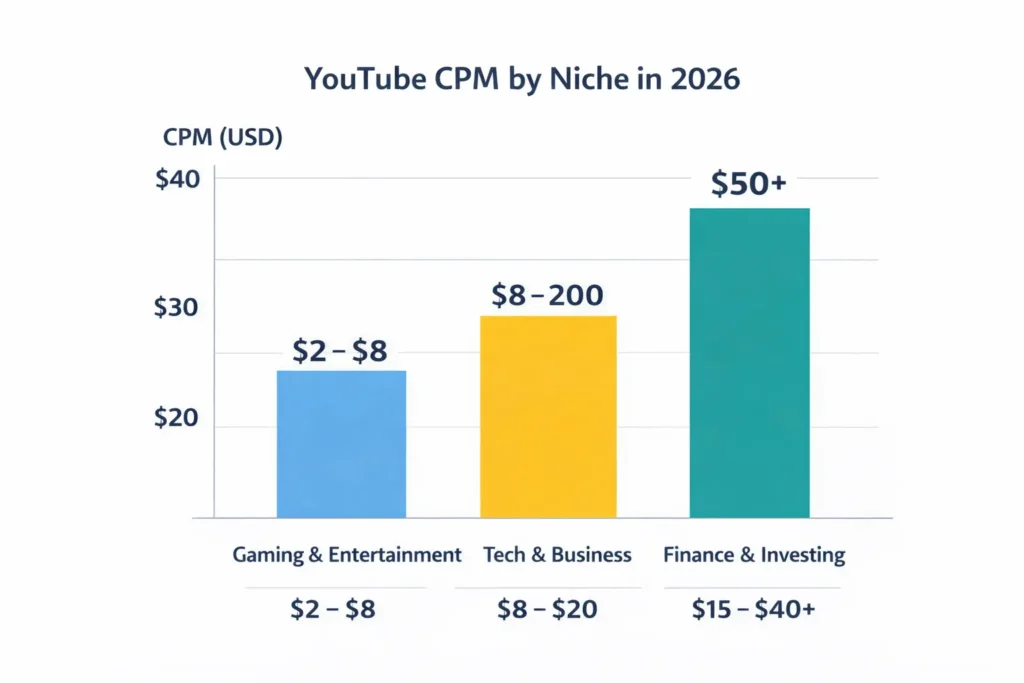
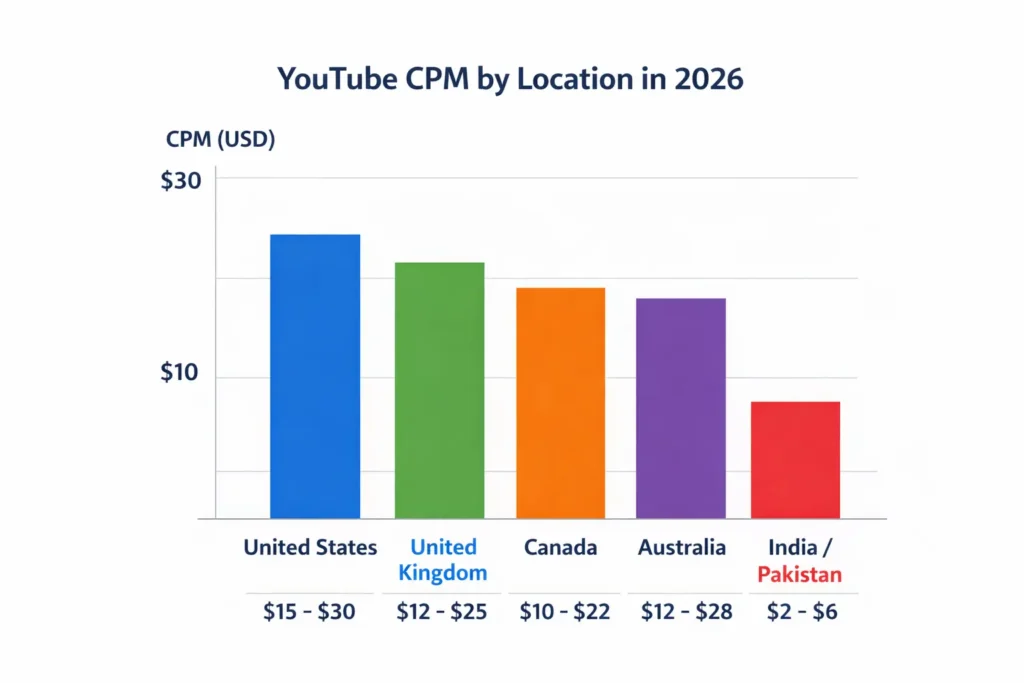
In 2026, niche and location affect CPM rates for YouTube. For example, from the above image we can see that gaming and entertainment have lower CPM rates than finance and investing. Moreover, content creators targeting audiences in countries like US, UK and Australia see a higher CPM rate than the ones from developing countries (India, Pakistan etc) as evident from the chart below.
It’s important to understand that the payout rates you see inside YouTube Studio are not the final amount creators recieve. YouTube keeps 45% of the ad revenue and gives 55% to the content creators (under YouTube Partner Program). This means your actual earnings per 1,000 views are reflected more accurately through a metric called RPM (Revenue Per Mille), which accounts for YouTube’s share and other monetization factors.
For example, if the advertiser CPM is $20, the creator may effectively receive around $11 after YouTube’s revenue share. If your video gets 100,000 monetized impressions at that rate, your estimated earnings could be around $1,100. Additionally, YouTube rates often increase during Q4 (October–December) due to higher advertising demand during holiday seasons.
Google AdSense CPM in 2026
Google ads are one of the most popular options for bloggers to generate ad revenue through web page content. Therefore, Google AdSense is a popular choice among bloggers for monetizing content through display ads. AdSense uses the CPM model to pay publishers based on ad impressions rather than conversion rate (click-through rate).
On AdSense, advertisers bid for ad space on your website and then Google sets a specific CPM rate based on these bids. Publishers then recieve a share of the ad revenue. The final earnings vary according to your niche, location, audience and traffic quality.
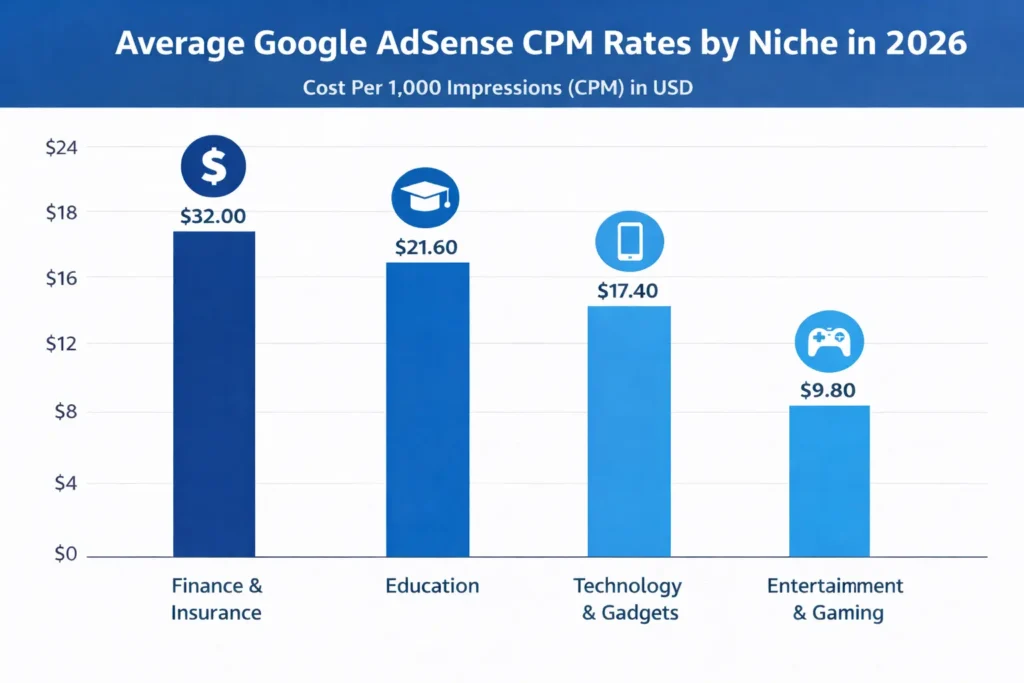
As evident from the chart above, finance & insurance offer the highest payouts. Whereas, entertainment & gaming offer the lowest rates. So, niche is an important factor in Google AdSense CPM rates in 2026. Moreover, traffic from developed countries (US, UK, Australia and Canada) offer higher rates in comparison to developing countries (Pakistan, India etc).
Actual Earnings and Google’s Share
The rates displayed in AdSense reports is not always the amount you will receive. Google may adjust the revenue based on ad auctions, ad formats, and invalid traffic detection. Effective earnings are calculated per 1,000 impressions, and high-quality traffic can significantly increase your revenue.
For example:
- Advertiser CPM: $15
- Effective CPM for publisher (after Google adjustments): ~$13
- Monetized impressions: 50,000
- Estimated earnings: ~$650
Like YouTube, AdSense rates also fluctuate throughout the year. Q4 (October–December) generally sees higher CPM due to increased advertising demand. Additionally, ad placement, device type, and page engagement impact CPM rates on your website. Understanding AdSense rates is crucial for publishers who want to optimize ad placement, grow traffic, and maximize earnings from their website in 2026.
Facebook CPM in 2026
In today’s digital advertising world, facebook remains one of the most popular platforms. Platforms like facebook are used by businesses to run brand awareness, traffic and conversion campaigns directly through CPM model. Advertisements on facebook are run directly through Meta’s Facebook Ads Manager which shows relevant ads to users. Facebook uses auction system where advertisers bid for specific audience segments based on:
- Location
- Age & demographics
- Interests
- Buying behavior
- Device type
Thus, the CPM rate depends on how competitive the audience is. Higher competition means higher CPM rate.
Average Facebook CPM rates in 2026
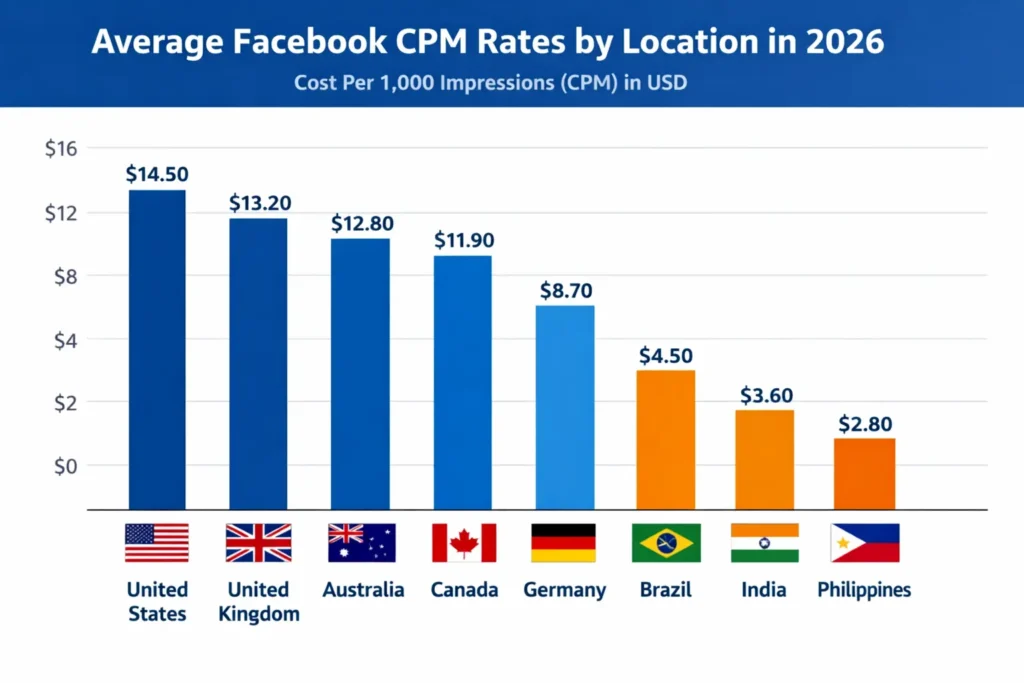
The chart above shows different rates in 2026 for facebook according to different locations. Advertisers pay higher rates for audiences based in US, UK, Australia and Canada due to higher purchasing power and strong economies. This makes every single impression valuable for advertisers.
Conversely, developing countries such as India, Pakistan, Afghanistan etc experience the lowest rates globally due to low average consumer spending and weak economies. Therefore, advertisers usually don’t invest aggressively in online advertising for these regions.
Niche is another primary factor that influences these metrics in 2026. As explained above, niches like SaaS, finance and insurance offer the highest payout rates. In contrast, gaming and entertainment offer the lowest payout rates.
Instagram CPM in 2026
Instagram is another popular online advertising platform in 2026. It uses the same Meta Advertising System as facebook, but CPM trends differ for the platform due to different style of content and a visually driven audience. Instagram ads appear between reels, in feeds, stories and explore placements and many brand awareness campaigns use CPM pricing model.
Average Instagram CPM in 2026
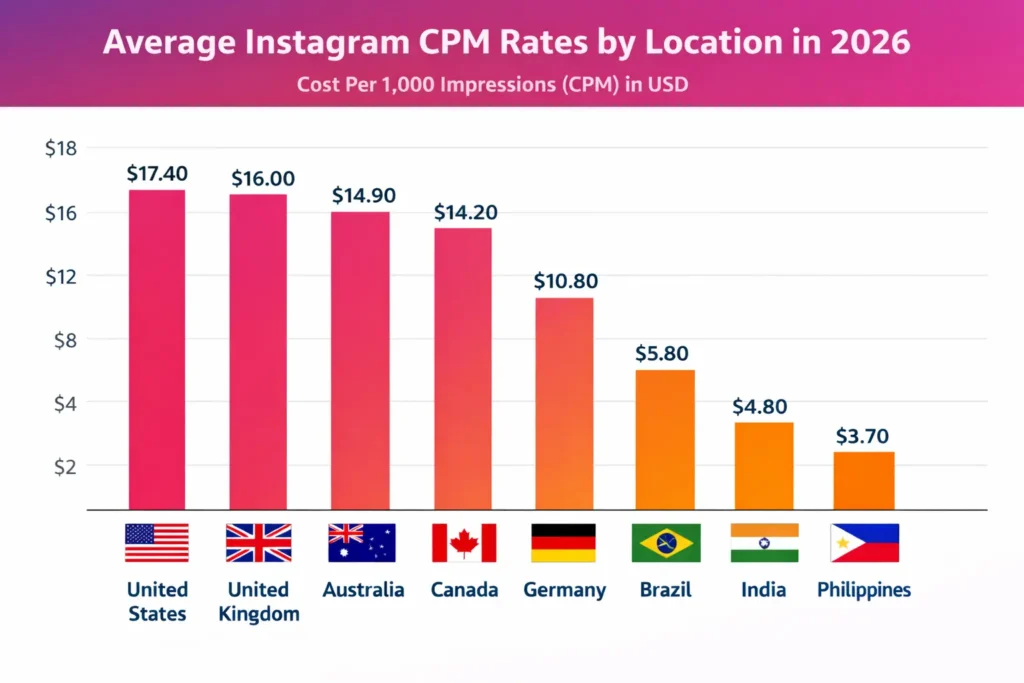
As explained in the chart above, Instagram rates are generally higher than Facebook for premium markets. Again, countries like US, UK, Australia and Canada see the highest rates in comparison to South Asian countries like India and Pakistan.
Since, Instagram is more influencer-oriented, these niches tend to be more suited for general audiences. Some of the most popular niches on Insta are:
- Travel
- Beauty & Skincare
- Fitness & lifestyle
- Fashion & luxury brands
Payout rates for these niches are given below in the chart.
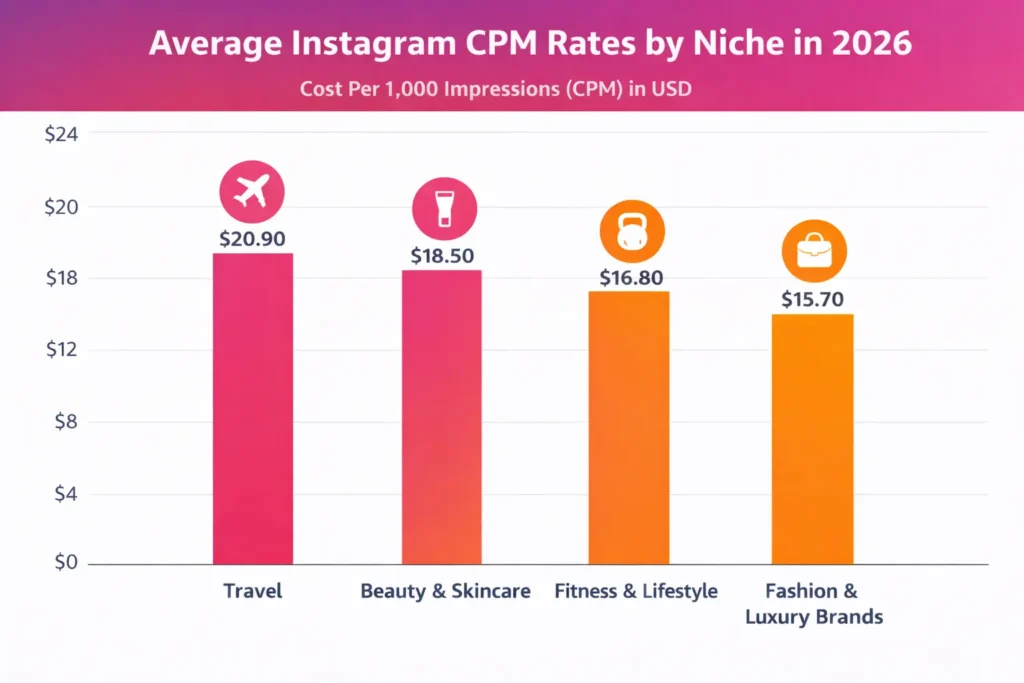
As evident from the chart above, travel and beauty & skincare offer the highest rates while fitness and fashion are lower than the latter. Therefore, choosing the right niche for Instagram is important.
Because Instagram is highly brand-oriented, companies in these industries are willing to bid aggressively for impressions. In contrast, general entertainment or low-commercial-intent content often receives lower CPM rates. Overall, Instagram rates tend to be influenced by:
- Audience purchasing power
- Engagement rate
- Visual appeal of the niche
- Advertiser competition
CPM rates aren’t fixed, they always fluctuate based location, niche and platform. This is why the answer to the question what is a good CPM isn’t so straightforward. There is no single “good” rate universally agreed upon. On average, a good rate can be $8 for your niche which would be considered bad for high-paying niches like finance and insurance. Whereas, publishers in developing countries might consider $10 rate good for them.
In contrast, such a rate for content creators from countries like US is considered average and not “good”. So, there is no single answer to this question. If you think you lag behind in payout rates relative to your rivals, then you should look for ways to increase your ad revenue rather than chase high-value niche or international audiences.
After understanding different rates across different platforms, niches and locations for 2026, let’s explore some ways to increase your cpm in 2026.
How to increase your CPM in 2026?
As we have seen that CPM depends a multitude of factors and it keeps changing constantly. So, maximizing ad revenue involves a mix or particular strategies. Let’s see how you can guarantee the highest income per thousand ad impressions.
1. Choose high-paying niches
Some niches pay higher than others. Target these high-paying ones if possible. For example, finance, insurance and technology pay the highest while entertainment or lifestyle offer modest payout rates. So, try and go for different target niches that would pay better.
2. Target international markets
Location is a critical factor in CPM rates. So, targeting audiences from countries such as US, Australia and Canada can have a huge impact on your ad revenue.
3. Focus on traffic quality and engagement
High-quality, engaged traffic attracts premium advertisers. Encourage longer session times, repeat visits, and interaction through comments or shares. Platforms reward creators with better CPMs when their audience is more active and engaged.
4. Use multiple ad formats
Video ads tend to be more influential than traditional banner ads on web pages. In order to maximize your ad revenue, target multiple ad formats. Experimenting with a combination of ad types can help increase your average rate while improving overall user experience.
5. Leverage seasonal trends
Some products tend to sell better in a specific season or occasion. For example, microwave ovens might see a higher demand during Christmas. Therefore, leveraging these seasonal trends can also have a great impact on your ad revenue especially if you are an affiliate marketer.
By focusing on these strategies, content creators can optimize their CPM and maximize revenue from every 1,000 impressions. Remember, a strong rate isn’t just a number, it’s about combining niche, audience, and engagement to get the most value from your content.
Conclusion
Internet has diversified the passive income streams in 2026. From affiliate marketing to content creation, almost everyone is looking to build an online brand nowadays. Therefore, mastering the concepts of CPM is no longer optional. It is a necessity to fulfill your financial goals. Remember, that there is no ideal CPM rate..
Different niches, platforms and locations have different rates. For example, $30 is considered a good CPM for finance and insurance niches. Conversely, $10 might be considered a good payout rate for niches like entertainment. Platforms like YouTube, Google AdSense, Facebook, and Instagram all operate differently, but the underlying principle remains the same: advertisers pay more when your audience is valuable to them.
Therefore, a competitive CPM rate is the one that aligns with your brand goals. In order to maximize your ad revenue, combine multiple streams and platforms. This ensures that you build long-term wealth without having to change your niche or target audience.
Do you have any questions? Let us know in the comments.
FAQs
What is a good CPM to have?
A good CPM depends on your niche and audience location. For entertainment content, $5–$10 can be considered good, while finance or insurance niches may see $20–$40+ rates. The key is comparing your payout rate within your specific niche.
Is a $20 CPM good?
Yes, a $20 CPM is generally considered strong, especially for most niches. In high-paying sectors like finance, it may be average, but for gaming or lifestyle content, it is considered very good.
How can I maximize my ad revenue?
You can increase ad revenue by targeting high-paying niches, attracting traffic from Tier 1 countries (US, UK, Canada, Australia), improving content quality, increasing watch time or session duration, and optimizing ad placements.
Why is my CPM so low?
Low CPM can result from traffic coming from lower-paying regions, low advertiser demand, poor audience engagement, seasonal trends, or content that advertisers consider less valuable.
Does higher CPM always mean higher earnings?
Not necessarily. Earnings depend on both CPM and total impressions. A creator with a lower payout rate but massive traffic can earn more than someone with a high rate and limited views.