
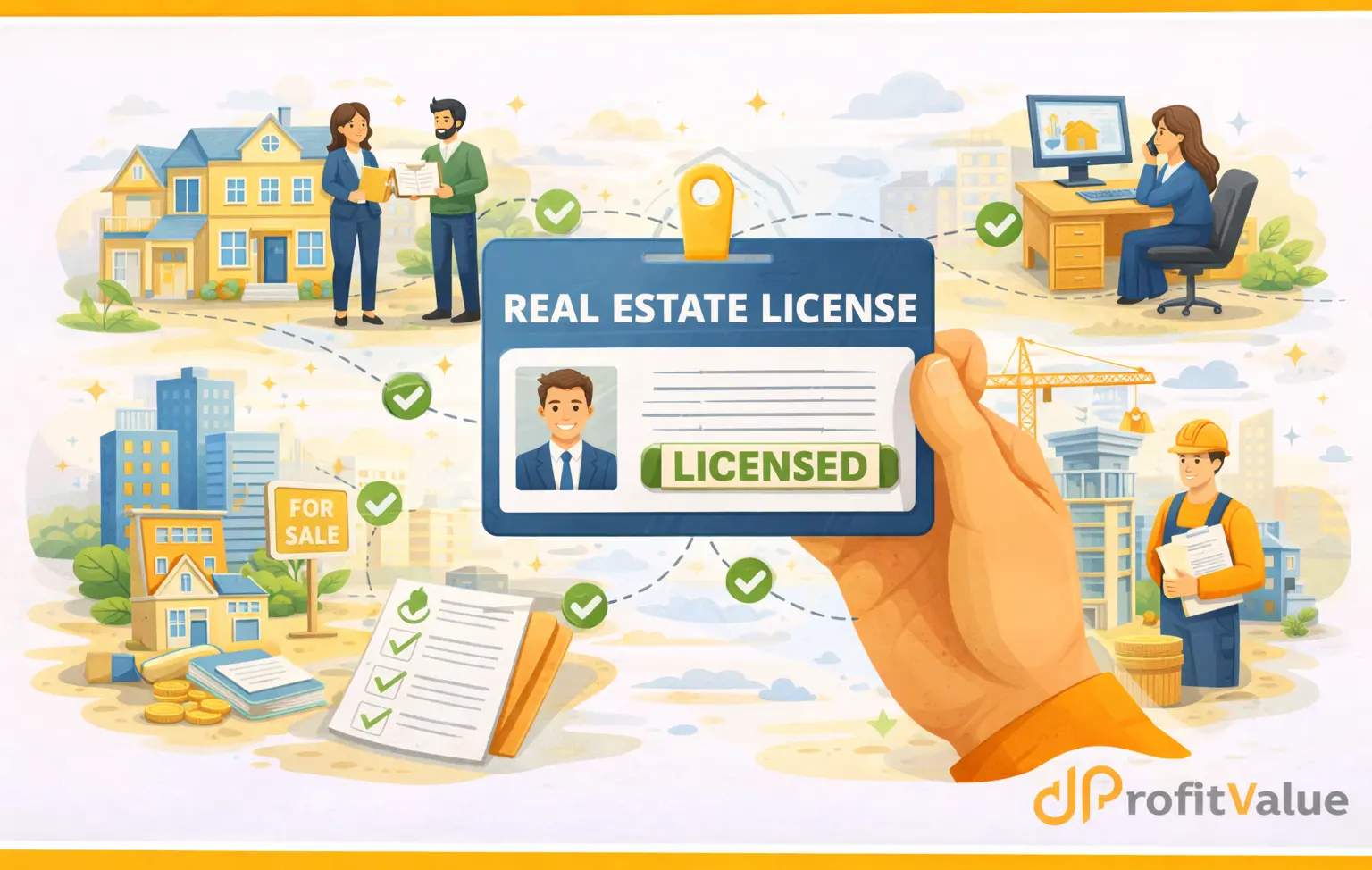
Real estate industry offers the most diversified career options for aspiring real estate agents across the world. From just selling residential and commercial properties to management roles, the industry is full of different career options to consider. So, if you have got a real estate license, you might be wondering what can you do with a real estate license? How do you decide which career option is best for you?
Well, the exact real estate job to choose depends on your own skills, interest and long-term goals. But there are many career paths to consider each offering competitive salaries as you gain experience. Moreover, you can also consider investing options as you build capital from working a job.
In this article, we will explain what can you do with a real estate license, different real estate career paths with their salaries and growth potential and which option to decide, all explained in simple words.
What Can You Do With A Real Estate License? Types Of Real Estate Careers

A real estate license opens the doors to a variety of different career paths for real estate agents to consider. Although, many people think real estate agents are just responsible for selling residential and commercial properties to buyers and real estate investors, there are many specialized roles as well you can choose as you build experience and network.
Keep in mind, that getting licensed as an estate agent itself involves pre-licensing education from a real estate school, background checks, initial money and some time. So, it is important to know how to get a real estate license in order to become an estate agent as soon as possible.
Once you get licensed, you now have the legal authority to represent clients in real estate transactions, earn commissions and within a brokerage. But its real value lies in the variety of career opportunities it offers for real estate professionals. Broadly, these opportunities can be divided into following categories:
- Traditional roles such as estate agent, real estate broker, and leasing agent
- Specialized roles including commercial real estate, residential real estate, property management, and appraisal
- Investment-focused paths like real estate investing and REIT-related careers
Each of these options offer different income potential with different skill requirements and long-term growth opportunities. Let’s look at these options in the following sections.
Traditional Career Paths For Real Estate Agents
The most common step after getting a license is entering a traditional real estate role, where you work directly with clients in property transactions. These roles are ideal offer for beginners as they offer a clear entry point in the industry for higher-paying roles in the future. Here are some of the most popular options.
1. Residential real estate agent
A residential real estate agent specializes in helping clients buy, sell or rent homes, condos or apartments. This is an ideal role for those who enjoy building relationships with individuals and families, understanding local neighborhoods, and guiding clients through an important phase of their lives. Residential agents work on commission per transaction and can build a strong network over time.
Key details
- Best for: People who enjoy personal client interactions and local market expertise
- Income potential: ~$40,000 – $90,000 per year (can go higher with high-value transactions)
- Incentives: Commission per transaction (typically 2–6%), bonuses from brokerages, referral income
- Skills required: Negotiation, marketing, interpersonal communication
- Work style: Flexible, client-driven schedule
How to pursue this career?
First, you will need to complete your pre-licensing courses from a real estate school as required by your state. Then, you will need to pass the licensing exam. After getting licensed as an agent, you will need to join a brokerage specializing residential properties. Then, start building a local network and client base through marketing, open houses and referrals.
2. Commercial real estate agent
Commercial real estate involves buying, selling and renting commercial properties such as offices, warehouses, shops and industrial facilities. This field tends to be more analytical and deal-focused for estate agents. Transactions are usually larger than residential real estate, lease terms are longer and this field requires understanding of commercial financing, leases and investment principles. So, understanding commercial real estate is essential to be successful in this field.
Key details
- Best for: People who enjoy personal client interactions and local market expertise
- Income potential: ~$40,000 – $90,000 per year (can go higher with high-value transactions)
- Incentives: Commission per transaction (typically 2–6%), bonuses from brokerages, referral income
- Skills required: Negotiation, marketing, interpersonal communication
- Work style: Flexible, client-driven schedule
How to pursue this career?
First, you will need to complete pre-licensing education and get licensed by your state. Then, you will have to seek mentorship under experienced commercial brokers. After getting mentorship, join a brokerage firm or a real estate company in your area. Build experience in leasing, sales and investment analysis. Then, build network in business communities for higher-value deals.
3. Leasing agent
Leasing agents help property owners rent out their properties. They work for property management firms or real estate brokers often serving as a point of contact between landlords and tenants. Leasing specialists require knowledge of lease contracts and legal terms for their state, so it is important to understand the responsibilities of a leasing agent. This role is ideal for those who enjoy customer service, showing properties to tenants and handle leasing contracts.
Key details
- Best for: People who enjoy business-to-business interactions, larger deals, and financial analysis
- Income potential: ~$60,000 – $150,000+ per year (with large commercial deals, earnings can be significantly higher)
- Incentives: Commission per deal (often higher than residential), bonuses from brokerage deals, long-term investment partnerships
- Skills required: Financial analysis, negotiation, networking, market research
- Work style: Entrepreneurial, deal-focused, client-driven
How to pursue this career?
Like the other options above, get licensed in your state by completing the necessary pre-licensing education. Then, join property management companies or leasing brokerages in your area. Learn about local market rentals, tenant laws and lease agreements. Then, build a client base through networking and referrals.
4. Real estate assistant
An estate assistant supports licensed brokers or agents with administrative, marketing or client-facing tasks. This is a strong choice for people looking to gain experience, understand transactions and prepare for a full agent or broker career.
Key details
- Best for: People who enjoy client interactions and flexible schedules
- Income potential: ~$35,000 – $60,000 per year
- Incentives: Commission per lease signed, performance bonuses, referral bonuses
- Skills required: Communication, negotiation, organizational skills
- Work style: Schedule-driven, client-focused, often part-time or full-time
How to pursue this career?
As explained above, get licensed in your state. A real estate license for this field is optional, but improves career prospects for transitioning into superior roles such as estate agent or leasing agent. Then, look for real estate assistant positions in estate agencies or brokerages in your area. Learn about marketing, client dealing and transaction processes. Then, start taking more responsibilities for transitioning to agent-level roles.
5. Real estate broker
A broker is a licensed agent who can operate independently, manage real estate offices and supervise other licensed agents. Brokers often earn higher commissions, can open their own brokerage accounts and mentor other agents. This role is ideal for you if have entrepreneurial ambitions in mind.
Key details
- Best for: People looking to start in real estate with flexible responsibilities
- Income potential: ~$30,000 – $50,000 per year
- Incentives: Performance bonuses, potential commission splits depending on the brokerage
- Skills required: Organization, communication, technology proficiency, multitasking
- Work style: Office-based or hybrid, supportive role to agents
How to pursue this career?
First, get licensed as real estate agent in your state. License is mandatory for this field. Then, gain experience of 1-3 years in an entry-level role. Complete broker-specific education and pass the exam to get a broker license. Then, consider opening your own brokerage account or manage a team of agents.
After understanding the traditional career paths for estate agents, let’s explore specialized roles in the industry.
Specialized Roles For Real Estate Agents
Apart from helping clients buying and selling properties, the industy offers many specialized roles for aspiring agents. These roles require additional certifications, continuing education or training, but can provide a higher earning potential compared to traditional options.
1. Real estate appraiser
A real estate appraiser evaluates properties to determine their market value for sales, mortgages, insurance and taxation purposes. Appraisers play a critical role in the real estate industry as the provide unbiased property valuations for acquisitions. According to Bureau of Labor Statistics, real estate appraisers earned an annual average salary of approximately $65,420 with certified professionals making over $130,000 in 2025. This earning potential makes it a strong choice for real estate agents.
Key details
- Best for: Experienced agents ready for leadership and management roles
- Income potential: ~$60,000 – $200,000+ per year (varies widely with office size and market)
- Incentives: Commission splits, office management fees, mentorship bonuses
- Skills required: Leadership, negotiation, business management, legal knowledge
- Work style: Managerial, entrepreneurial, often client- and business-driven
How to pursue this career?
First, you will need a real estate license in your own state. Many states allow licensing to expedite appraisal training. Then, pursue appraisal education as required by your state along with relevant certification. Gain experience under a licensed appraiser as a trainee. Lastly, pass the state licensing exam and pursue specialized certifications for commercial or residential appraisals.
2. Real estate investor
A real estate investor buys, sells or rents commercial or residential properties for investment purpose taking advantage of property appreciation. Investors require large upfront capital, market knowledge, negotiation skills and licenses to identify opportunities in different types of properties.
Key details
- Best for: Entrepreneurial individuals seeking passive or active income
- Income potential: Highly variable; ~$40,000 – $200,000+ per year based on investments
- Incentives: Rental income, property appreciation, tax benefits, and portfolio growth
- Skills required: Market analysis, negotiation, financial literacy, risk management
- Work style: Flexible, independent, investment-focused
How to pursue this career?
Use your real estate license to access off-market deals and MLS listings. Then, start with residential properties initially and later expand to mixed-use complexes or commercial units. Establish industry connections with experienced investors, brokers and agents for opportunities. Lastly, keep learning actively about financing, tax strategies and property management to mitigate risks.
3. Real estate consultant
Real estate consultants advise clients on what properties to buy. They suggest different kinds of properties such as commercial, residential or industrial depending on their specialization.
Key details
- Best for: Experienced agents or brokers looking to focus on advisory services
- Income potential: ~$60,000 – $150,000+ per year
- Incentives: Consulting fees, performance bonuses, client retainer agreements
- Skills required: Market research, negotiation, client management, problem-solving
- Work style: Client-focused, advisory, often independent or consultancy-based
How to pursue this career?
First, get licensed as an estate agent in your state. Gain experience in sales or brokerage. Start by building expertise market analysis and investment strategies. Then, join a consultant firm or offer services as an independent consultant. Network with other investors and corporate clients to expand your services.
4. Property manager
Property managers are responsible for overseeing the day-to-day operations of a commercial or residential property for maximum profit. They handle maintenance, leasing and financial management of a property. Property managers have a strong market potential making property management a good option for estate agents.
According to US Bureau of Labor Statistics, real estate, property and community association managers earned a median annual wage of $65,000 to $70,000 in 2023, making it a strong choice among other real estate jobs.
Key details
- Best for: Experienced agents or brokers looking to focus on advisory services
- Income potential: ~$60,000 – $150,000+ per year
- Incentives: Consulting fees, performance bonuses, client retainer agreements
- Skills required: Market research, negotiation, client management, problem-solving
- Work style: Client-focused, advisory, often independent or consultancy-based
How to pursue this career?
Like other options mentioned above, get licensed as an estate agent first. A real estate license is mandatory in most for property management roles. Gain experience through property assistant or leasing agent roles first. Learn about tenant laws, property maintenance and financial reporting. Then, apply for property management positions or manage your own investment portfolio.
5. Corporate roles
A real estate license combined with the right educational background opens the doors to many corporate positions as well. Such corporate positions are financial analysis, property management and leasing agent roles in REITs companies. REITs companies produce over millions of corporate roles each year globally making it a strong option for real estate agents.
Key details
- Best for: Experienced agents or brokers looking to focus on office-based roles
- Income potential: ~$60,000 – $150,000+ per year depending on experience
- Incentives: Performance bonuses, client retainer agreements and other corporate incentives
- Skills required: Market research, negotiation, client management, problem-solving
- Work style: Corporate setting
- Education required: Bachelor’s degree in Finance, Business, Economics or Real Estate along with relevant certifications such as CFA or CPM
How to pursue this career?
First, pursue a bachelor’s degree in any one of the fields described above. Then, get licensed as a real estate agent. Gain experience in entry-level roles such as leasing agent or property assistant positions. Then, start applying for corporate positions in REITs companies in your area.
Now let’s understand the investment-focused paths for real estate agents.
Investment-Focused Career Opportunities
A real estate license unlocks many investment-focused career paths as well for aspiring entrepreneurs. You can buy and hold properties for profit. Additionally, you can hire tenants and earn rental income from your portfolio. Commercial properties generate more revenue than residential properties making property investing a strong option for like-minded individuals.
1. REITs companies
Many entrpreneurs don’t have starting capital to purchase and manage a property themselves. Buying a property is one thing, but managing it is also costlier. That’s where REITs companies come in. You can purchase shares in these companies without buying a property yourself.
Key details
- Best for: Beginners or those seeking passive, low-effort investing
- Income potential: ~4% – 10% annual returns (dividends + appreciation)
- Incentives: Passive income, diversification, liquidity (public REITs)
- Skills required: Basic financial analysis, understanding of real estate markets
- Work style: Fully passive, requiring minimal involvement
How to pursue this career?
First, research about different types of REITs companies (mortgage, equity, hybrid etc). Then, invest through stock exchanges or brokerage platforms. Analyze dividend yield, occupancy rates and asset portfolio. Then, slowly and gradually, diversify your investment across different sectors (commercial, residential, industrial).
2. Buy-and-hold (rental property investment)
This strategy involves purchasing properties and renting them out for consistent monthly income while benefiting from long-term appreciation. A license helps you identify profitable rental markets and reduce acquisition costs.
Key details
- Best for: Individuals seeking passive income and long-term wealth
- Income potential: ~$500 – $5,000+ monthly per property (varies widely)
- Incentives: Rental income, property appreciation, tax advantages
- Skills required: Financial analysis, tenant management, long-term planning
- Work style: Semi-passive, scalable over time
How to pursue this career?
First, start with single-family or small multi-family properties. Analyze cash flow, cap rate and rental demand. Consider hiring a property manager if you can’t be actively involved all the time. Accumulate your profits over time and diversify your investments to more properties.
After exploring the career paths to choose from, let’s now summarize all the career options we have covered so far.
Summary Of Different Career Paths
With so many options available, it can become challenging to interpret a lot of information at once. Hence, it can be difficult to decide the best career path. Therefore, the table below summarizes the career options we have covered so far.
| Career Path | Income Potential | Work Style | Difficulty Level | Best For |
|---|---|---|---|---|
| Residential Agent | $40K – $90K+ | Active | Medium | People-oriented beginners |
| Commercial Agent | $60K – $150K+ | Active | High | Business & finance-focused individuals |
| Leasing Agent | $35K – $60K | Active | Low–Medium | Entry-level, flexible roles |
| Real Estate Assistant | $30K – $50K | Supportive | Low | Beginners gaining experience |
| Broker | $60K – $200K+ | Managerial | High | Experienced professionals |
| Appraiser | $50K – $100K | Analytical | Medium | Detail-oriented individuals |
| Property Manager | $45K – $90K | Operational | Medium | Organized, process-driven people |
| Rental Investor | Varies ($500–$5K+/month) | Semi-passive | Medium | Long-term wealth builders |
| REIT Investor | 4%–10% returns | Passive | Low | Passive income seekers |
| Corporate REITs roles | $60K-$150K | Corporate, office-based | Medium-High | Experienced industry pros |
Conclusion
This article has explained what can you do with a real estate license in detail by covering different career options. Some of the options are entry-level roles, while some of them are investment-focused. And, some roles are more corporate and analytical. Deciding the best career path depends on your long-term goals and interest in a particular field.
But the industry offers several passive ways to build money with real estate. So, as you get more experience and save money from your job, you can grow your own portfolio as well diversifying your income streams.
With the right mindset and knowledge, you will definitely choose the right career and pursue your long-term goals successfully. Do you have any questions? Let us know in the comments.
FAQs
What can you do with a real estate license?
You can work as an agent, broker, leasing agent, property manager, or explore investing paths like rentals, flipping, and REITs.
Is a real estate license worth it?
Yes, it can open multiple income streams, including commissions, management fees, and investment opportunities.
Do you need a real estate license to invest in property?
No, but having a license gives you better access to deals, market data, and commission savings.
What is the highest-paying real estate career?
Commercial real estate agents, brokers, and investors typically have the highest earning potential.
Can you make passive income with a real estate license?
Yes, through rental properties, REITs, and syndication deals, though some require initial active effort.