
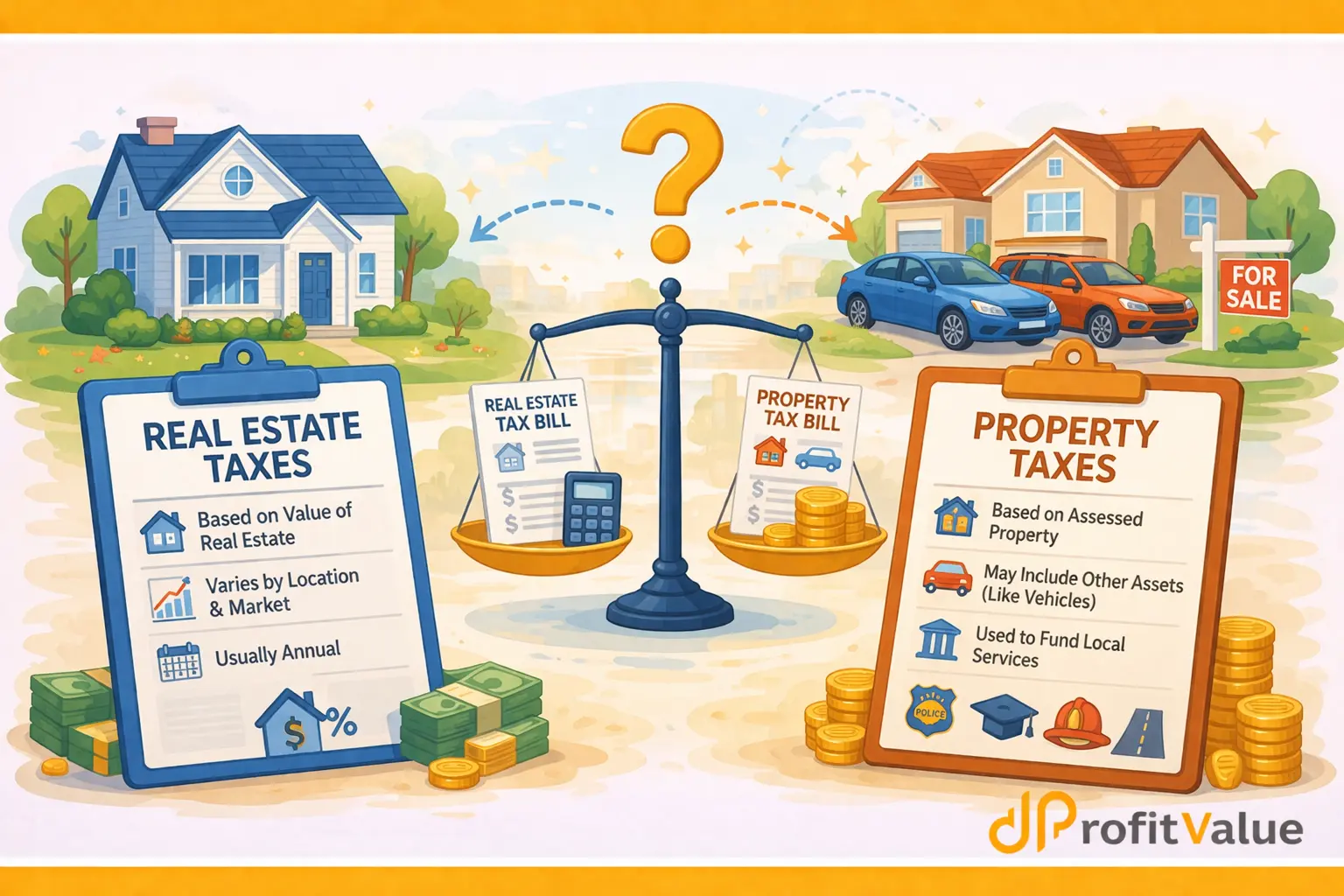
Almost every earning person across the world pays taxes one way or the other. Two of the most common types of taxes paid by Americans are property taxes and real estate taxes. However, many people use these terms interchangeably. This leads to confusion between the two concepts. Therefore, the most common question is: Are real estate taxes the same as property taxes?
The short answer is property is a broad term. It covers a variety of movable and immovable assets such as vehicles and business machinery. Whereas, real estate is just one of the categories of property taxes applying specifically to land, buildings and houses.
This article will explain if real estate taxes are the same as property taxes, why people often mix-up these terms, and explain real-world examples to understand how both concepts work.
Are Real Estate Taxes The Same As Property Taxes? Real Estate Vs Property Taxes
No, real estate tax and property taxes are not the same thing. But they are closely related, which is why many people use them interchangeably. Property taxes apply to all of your personal properties such as business equipment, vehicles, boats etc. Hence, they are also sometimes called personal property taxes.
On the other hand, real estate taxes are just one category of property taxes. It applies specifically to buildings, homes, shops etc. People confuse it because many conuntries and local governments mainly impose taxes on real property such as homes and shops. As a result, people confuse the two terms even when property taxes cover a wider range of local tax rates other than land or immovablle objects.
After understanding the difference between the two terms, let’s explore the concept of real estate tax in detail and how local governments tax different types of properties.
What Is Real Estate Tax?
Real estate taxes are a type of federal taxes imposed by local governments on immovable property such as homes, offices, shops, apartment complexes and land. It is one of the most common types of taxes paid across the globe by property owners to local tax assessors for funding essential public services such as schools, road maintenace and emergency services.
The amount of real estate taxes you pay are assessed on your property value and the local property tax rates set by the government. For example, if you own a home or a shop, you will be required to pay real estate tax annually based on its market or assessed value.
In most countries, real estate tax is the primary form of property-related taxation. This is one of the main reasons why people often assume that real estate tax and property tax are the same, even though property tax can include other types of assets as well.
After understanding what is real estate tax, let’s see how to calculate it with real examples.
How real estate taxes are calculated?
In many countries especially the US, real estate taxes are calculated by the government not the IRS. However, the IRS provides guidance on how these taxes are treated for federal tax purposes, especially when claiming deductions. If you are looking for ways to build passive income with real estate, then understanding these tax obligations is crucial.
1. How do governments calculate real estate tax
In most cases, the real estate tax is calculated by multiplying the assessed value of the property with the local tax rate. For example, if the value of your property is $300,000 and your local tax rate is 1.5%, then the annual tax owed to the government would be $4500. The assessed value is determined by your local tax authorities. And, the tax rate varies by country, state, city and the property type.
Keep in mind, that different property types (residential, commercial or industrial) are taxed differently in different regions. So, it is recommended to check with your local laws to understand your tax obligations better.
2. How the IRS Treats Real Estate Taxes
According to the IRS, real estate taxes can be deductible if they meet certain conditions. For example:
- The tax must be based on the assessed value of the property
- It must be imposed uniformly on all properties in the area
- It must be used for general public welfare, not specific services
The IRS also clarifies that not all charges on a property tax bill are deductible. Fees for services like trash collection or water usage are not considered real estate taxes.
After understanding the real estate tax, let’s understand the broader concept of property taxes.
What Is Personal Property Tax? Understanding Personal Property Tax Rates
As explained above, personal property taxes refer to taxes imposed on different types of properties. In most cases, personal property tax applies to both movable and immovable assets. While real estate tax refers to taxes imposed on land and buildings, property tax can also include taxes paid on personal possessions such as vehicles and business equipment.
These may include:
- Residential and commercial real estate
- Vehicles such as motorcyles, cars, trailers or boats
- Business equipment and machinery
However, in many regions, property tax mainly refers to taxes on real estate alone. This overlap in usage is one of the main reasons why people often assume that property tax and real estate tax are the same. Let’s now understand how to calculate property tax for different types of properties.
How to calculate personal property taxes?
The method of tax assessment for different types of personal properties can vary based on the type of asset and local regulations. However, it follows a similar approach of multiplying the assessed value of your asset with the local tax rate. We have already explained how to pay property taxes for real estate. So, in this section we will only be covering vehicles and business equipment.
1. Vehicle taxes (cars, boats etc)

For movable taxes such as vehicles, the tax is often calculated based on market value or depreciated value and fixed local rates or percentages. For example, a vehicle may be annually taxed as personal property based on its market value. The IRS allows deductions for certain vehicle-related personal property taxes if they have a market value.
For example:
- A car tax based on its value may qualify
- Flat registration fees or fixed charges do not qualify
The IRS explains that state and local personal property taxes on motor vehicles can be deducted if you itemize your return.
2. Business property (equipment, machinery)

Many jursidictions impose personal property taxes on business assets such as equipment, machinery and inventory in some cases. These are usually assessed periodically and taxed accordingly.
If you use personal property for business purposes:
- You may deduct the business portion of personal property taxes
- These are reported on forms like Schedule C or Schedule F
According to IRS, business assets may be subject to depreciation rules, depending on how they are used.
After understanding how to calculate personal property taxes, let’s see some real life examples of both personal properties and real estate tax rates.
Real-Life Examples Of Real Estate Tax Vs Property Tax
Understanding real estate and property taxes becomes easier when we look at some real-life examples. Let’s understand how these taxes apply in everyday situations.
1. Residential property
If you own a residential property such as a house or an apartment, you will owe real estate tax to the government. For example, if your home is worth $300,000 and the local rate is 1.5%, then the annual tax would be paid $4500 to your local tax authorities.
2. Vehicles
Some regions impose personal property taxes on vehicles. So, it is recommended to check with your local laws. For example, if you own a car worth $25,000 and the local rate is 1%, then the annual tax owed would be $250. This is not a real estate tax, but it is considered a property tax since it applies to movable assets.
3. Business equipment
Tax authorities might impose property tax on business equipment like machinery or office computers. For example, if a company purchases $100,000 worth of business equipment at a 2% local rate, then the annual tax would be $2,000.
4. Commercial real estate
Commercial property owners might pay both real estate and personal property taxes. Real estate rates will be calculated based on the value of the building and land, while personal property rates could apply to equipment inside the building.
Conclusion
In essence, both real estate and property taxes are closely related terms, but not exactly the same. Real estate tax is just one category of property tax applying specifically to land and buildings. Whereas, property tax covers a wide range of movable and immovable assets (including real estate) like office equipment or vehicles.
Many people use these terms interchangeably since tax authorities focus a lot on real estate. However, property taxes apply to other tangible items as well. Understanding these concepts clearly is essential to manage your finances better. Do you have any questions? Let us know in the comments.
FAQs
Are real estate taxes and property taxes the same?
No. Real estate tax applies only to land and buildings, while property tax is broader and can include vehicles, business equipment, and other assets.
How are real estate taxes calculated?
Real estate taxes are calculated using the formula: Assessed Property Value × Local Tax Rate. Local governments determine the assessed value and tax rate.
Can personal property taxes be deducted on my federal return?
Yes, certain personal property taxes based on the value of movable assets, like vehicles, may be deductible if you itemize, according to IRS rules.
Do all countries treat property tax the same way?
No. Tax rules vary by country. Some only tax real estate, while others also tax movable assets like vehicles and business equipment.
Why do people confuse real estate tax with property tax?
Most local taxes focus on real estate, and everyday language often uses “property tax” to mean home or land taxes, causing confusion.