
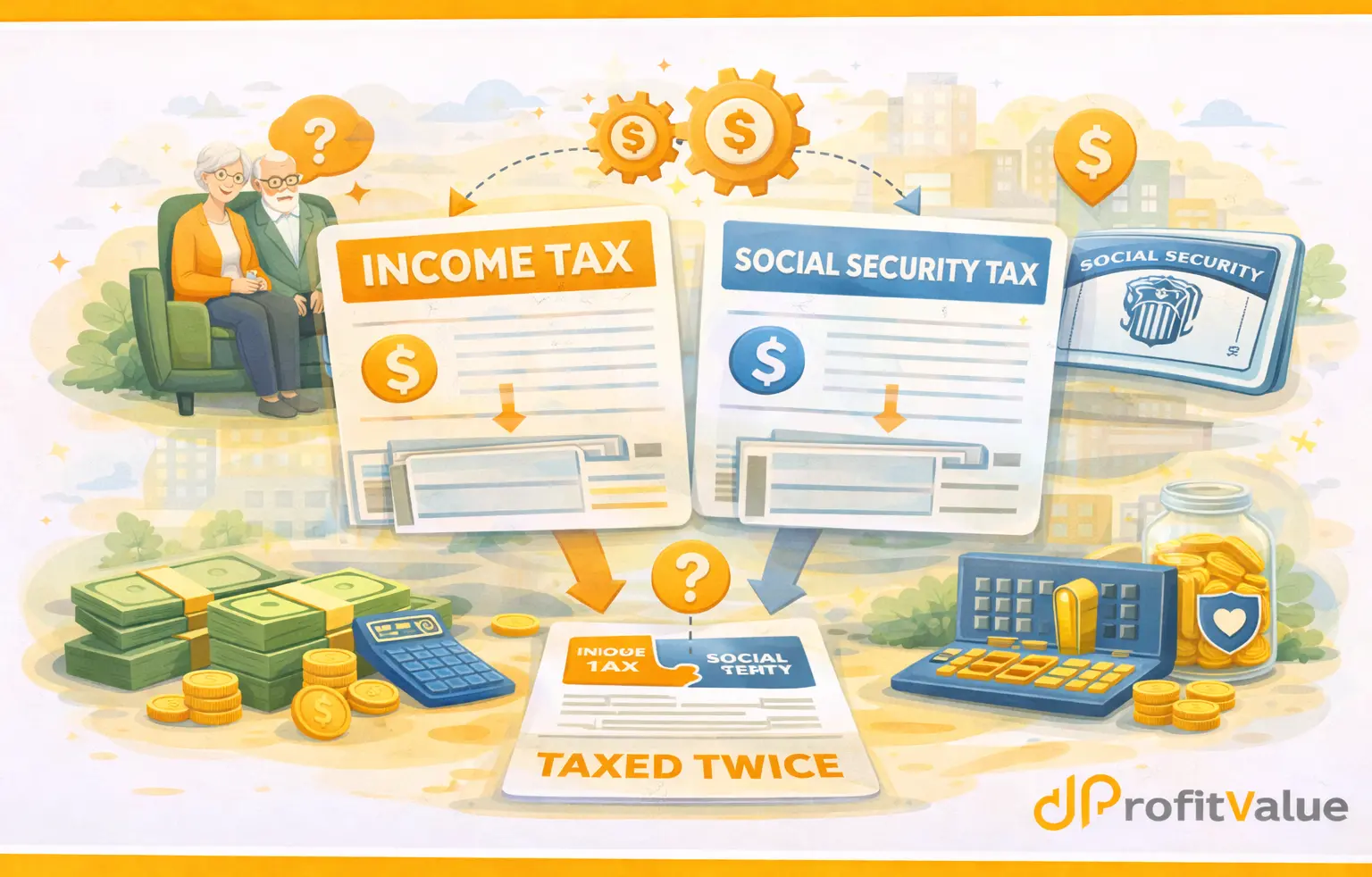
According to Social Security Administration (SSA), approximately 71.6 million Americans recevied benefits from the programs administered by SSA. However, nothing is free. Americans are required to pay a certain portion of their income in these taxes to fund the program. And, very often people are required to pay taxes on social security benefits as well that they receive in their retirement. This creates a perception of double taxation. Therefore, many people wonder why is social security taxed twice?
The reality is more nuanced. While it may feel like getting taxed twice, social security benefits are taxed under specific conditions. And, not everyone is required to pay taxes in their retirement. This article will explain why is social security taxed twice and what you can do to minimize the impact.
Why Is Social Security Taxed Twice? Taxes On Social Security Explained

Many people think that social security is taxed twice. But that’s not entirely accurate. The confusion comes from two different types of taxes paid at different stages of your financial life.
First, during your working years, you pay payroll taxes commonly known as FICA taxes. This is confused by many people as the federal income tax. However, it is important to understand the difference between FICA taxes and federal income tax to plan your financial strategies effectively.
Then, in your retirement stage, you may be expected to pay taxes on benefits you receive. However, you are only expected to pay taxes when your total income exceeds certain thresholds which we will discuss later in the article. This makes many people feel like getting taxed again. Therefore, people think that social security is taxed twice.
However, these are two totally distinct mechanisms. FICA Taxes are payroll taxes that fund the social security system, while getting taxed again on social security benefits depend on your overall financial situation in retirement. Not everyone is supposed to pay this tax, and in such cases, only a portion of the payment may be taxable.
So, while, it may feel like that social security taxes Americans twice, it is more accurate to say that the system taxes you twice under different conditions.
Social Security Taxes during your working years
During your working years, you pay two kinds of payroll taxes:
- FICA Taxes
- Medicare taxes
Contributions to social security system through FICA taxes along with certain work history makes you eligible for receiving social security benefits. Whereas, Medicare taxes will make you eligible for receving healthcare at the retirement stage.
A portion of your income (6.2% rate for employees) is automatically deducted on your paycheck, with your employer contributing an equal amount. This is known as FICA Taxes. Income exceeding the wage base limit of $184,500 will not be taxed additionally for social security purposes.
These taxes are not stored in a savings account for you by the government. Rather, this money is used to fund the social security system of the US which provides benefits to retirees, disabled individuals and families of deceased workers. In other words, you are contributing to a system rather than paying for your own benefits.
Many people are also confused when they see an OASDI deduction on their paycheck, so, it is important to learn about OASDI Tax and how it connects to the overall FICA Taxes system.
Taxes on Social Security benefits in retirement
According to the IRS, once you retire and begin receving social security benefits, your payments may be subjected to income tax, but only if it exceeds certain thresholds.
Your “combined income” (which includes adjusted gross income, nontaxable interest, and half of your Social Security benefits) determines whether your benefits are taxed. Depending on your income level, up to 50% or even 85% of your benefits may be taxable.
However, it is important to note that many retirees with lower income levels pay no taxes on social security benefits.
Why it feels like double taxation?
The idea of double taxation is perceptive. People pay FICA and social security taxes during their working years, so, they naturally expect the benefits to be tax-free later. But when, taxes are applied again later on, people feel like paying the same money again.
However, income tax is applied on overall income, and not just because it must exist in this particular case. This is why, when you receive social security benefits, and, your income exceeds certain limits, you might pay a certain percent of your earnings in tax.
The point is, that it is income tax, and, not taxes on retirement benefits. If your income is lower than the limits described the IRS, then, you won’t be required to pay any taxes on the benefits you receive.
Difference between payroll taxes and income taxes
To understand, why social security isn’t taxed twice, it’s important to understand the difference between the two types of taxes involved.
- Payroll taxes (FICA): Collected during your working years to fund the Social Security system
- Income taxes: Applied in retirement based on your total income level
These taxes serve different purposes. Payroll taxes are collected to fund the social security system. In contrast, income taxes are based on your ability to pay during retirement.
Because these systems have different conditions, it isn’t technically double taxation in the strict sense.
An example to understand the process
Let’s understand the process with an example. Suppose that in your career, you earned $60,000 annually and paid social security taxes through payroll deductions. Over time, these contributions help fund the system.
In retirement, you receive $25,000 annually in social security benefits. If your total retirement income exceeds this limit, a portion of your $25,000 may become taxable.
This sequence of paying into the system first during your career, and, then paying taxes on the benefits received is what creates the perception of double taxation. In reality, these are different systems governed by different conditions. After understanding if social security is taxed twice, let’s understand who is required to pay the income tax in retirement.
Who Pays Taxes On Social Security Benefits? SSA Guidelines Explained
Not all retirees are required to pay taxes on their ss benefits. In order to determine eligiblity for filing income taxes on ss benefits, IRS uses a term “combined income”. This factor determines whether part of your earnings are taxable.
According to SSA, combined income (also called provisional income) is calculated as:
Adjusted Gross income + non-taxable interest + 1/2 of your social security benefits
The taxability of your social security benefits depend on your combined income and filing status.
Tax thresholds for social security benefits in 2026
| Filing Status | Combined Income | Portion of Benefits Taxable |
|---|---|---|
| Single, head of household, qualifying widow(er) | ≤ $25,000 | 0% taxable |
| Same single filing | $25,001 – $34,000 | Up to 50% taxable |
| Same single filing | > $34,000 | Up to 85% taxable |
| Married filing jointly | ≤ $32,000 | 0% taxable |
| Married filing jointly | $32,001 – $44,000 | Up to 50% taxable |
| Married filing jointly | > $44,000 | Up to 85% taxable |
| Married filing separately (lived with spouse at any time) | Any amount | Up to 85% taxable |
This means that:
- If your combined income is below the base amounts ($25,000 single or $32,000 joint), then no portion of your income will be taxable.
- If your combined income falls into the middle range, up to 50% of your ss benefits may be taxable.
- If your combined income exceeds the maximum threshold, then, up to 85% of your ss benefits may be taxable.
These rules apply whether your income comes from retirement, survivors or disability benefits. However, Supplemental Security Income (SSI) is not taxable.
Why these thresholds matter?
These combined income thresolds have not been adjusted for inflation for many years, meaning that more retirees are pushed into taxable territory over time even if their income hasn’t significantly changed.
Knowing where you fall in this scale helps you with effective retirement planning for a secure financial future. After understanding who pays taxes on ss benefits, let’s see how to minimize the impact of paying taxes on the benefits you receive.
How To Minimize The Impact Of Taxes On Social Security Benefits?
Althoughm you might not be able to completely eliminate taxes legally on social security benefits, there are a few steps you can take to reduce the taxes owed. Taxes depend on your combined income, so, managing that number is what minimizes the impact of taxes on the benefits received.
Keep Your Income Below Key Limits (If Possible)
The IRS calculates whether your benefits are taxable based on your combined income, which includes:
- Your adjusted gross income (AGI)
- Tax-exempt interest
- 50% of your Social Security benefit
If your income stays below:
- $25,000 (single)
- $32,000 (married filing jointly)
…then your Social Security benefits may not be taxed at all.
Simple strategy:
Try to avoid large withdrawals or extra income in a single year that could push you above these limits.
Spread Out Your Withdrawals
Taking too much money from retirement accounts in one year can increase your taxable income.
Simple strategy:
Instead of withdrawing a large amount at once, spread withdrawals across multiple years to stay in a lower tax range.
This helps you avoid having up to 85% of your benefits taxed.
Use Roth Accounts When Possible
Money withdrawn from Roth IRAs is generally not included in the IRS combined income formula.
Simple strategy:
If you have both traditional and Roth accounts:
- Use Roth withdrawals when you’re close to income limits
- This keeps your taxable income lower
Consider Delaying Your Benefits
Delaying Social Security can increase your monthly payments and give you more control over when you start receiving taxable income.
Simple strategy:
If you have other income sources early in retirement, delay claiming benefits so you don’t stack multiple income streams at once.
Adjust or Withhold Taxes in Advance
The IRS allows you to voluntarily withhold taxes from your Social Security payments to avoid a surprise tax bill later.
- You can use Form W-4V (Voluntary Withholding Request
- Or make estimated tax payments if needed
Simple strategy:
If you know your benefits will be taxable, set aside or withhold taxes early so you’re not caught off guard.
Review Your Situation Every Year
Tax rules and your income can change from year to year. Even small differences in income can affect how much of your benefits are taxed.
Simple strategy:
Check your income annually and adjust withdrawals or income sources to stay within favorable thresholds.
Conclusion
This article has cleared up the confusion of social security being taxed twice along with strategies to reduce taxes on the benefits you receive. The confusion arises from two different stages of paying taxes. First, paying payroll taxes (FICA & Medicare taxes) in your working years.
And, then paying income tax on the benefits you receive in your retirement stage. This makes people feel double taxation. However, you are taxed only when your income crosses certain thresholds. By understanding how to minimize the impact of income tax legally on the benefits you receive, you can plan your financial future effectively. Do you have any questions? Let us know in the comments.
FAQs
Is Social Security really taxed twice?
No, it’s not technically taxed twice. You pay payroll taxes while working and may pay income tax on benefits in retirement, but these are two separate tax systems.
At what income is Social Security not taxable?
If your combined income is below $25,000 (single) or $32,000 (married filing jointly), your benefits are generally not taxable.
How much of Social Security benefits can be taxed?
Depending on your income, up to 50% or 85% of your benefits may be taxable, but not the full amount.
Do all retirees pay taxes on Social Security?
No. Many retirees with lower incomes do not pay any federal tax on their Social Security benefits.
Can I avoid paying taxes on Social Security?
You may not be able to avoid taxes completely, but you can reduce them legally by managing your income, using Roth accounts, and planning withdrawals carefully.