
Real estate is one of the fastest growing sectors across the globe. From managing residential and commercial properties to actually working in corporate roles, the industry offers diverse options for career seekers. This raises the question: how many jobs are available in real estate investment trusts? And, what exactly are REITs companies?
REIT are companies that own and manage properties. There are many kinds of REITs companies based on the type of property they manage. Therefore, the field offers several promising opportunities for you to pursue. But should you consider it as a career option?
This article will explain how many jobs are available in real estate investment trusts supported by real world data along with different kinds of opportunities you can explore.
How Many Jobs Are Available In Real Estate Investment Trusts? Breakdown For 2026
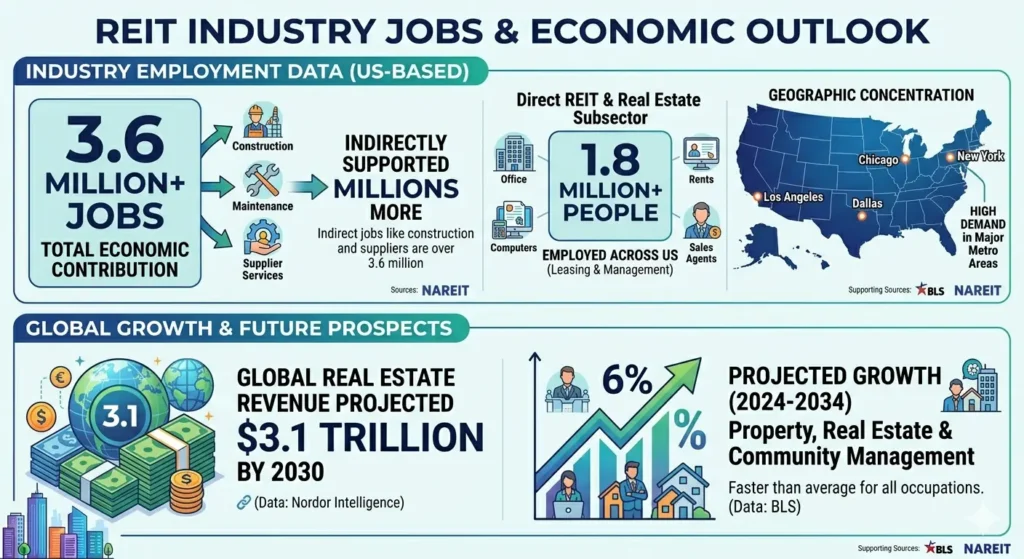
According to Bureau of Labor Statistics (BLS), real estate subsector which includes companies that lease and manage properties employed more than 1.8 million people across the US for various occupations such as property managers, sales agents, and general operations roles.
Additionally, REITs indirectly supported millions of other jobs through construction, maintenance and supplier services with a total economic contribution of over 3.6 million jobs when direct and indirect employment are combined. This data is supported by nareit and other industry reports.
Moreover, the real estate industry is projected to reach a revenue of $3.1 trillion by 2030 according to Nordor Intelligence. This shows that not only job opportunities continue to grow in real estate market, but you can also take advantage of investment opportunities in the future.
Geographic concentration of jobs
Most REIT sector jobs are concentrated in major metropolitan areas where real estate activity is high. Cities like New York, Chicago, Dallas and Los Angeles have the largest demand due to the volume of commercial, residential and industrial properties under management.
Future prospects
Employment in property, real estate, and community association management is projected to grow by 6% from 2024 to 2034, faster than the average for all occupations, according to the BLS. This indicates strong long-term prospects for individuals pursuing careers in REITs.
After understanding how many jobs are available in real estate investment trusts and the future trends, let’s explore the different job opportunities available for you to consider.
Job Opportunities In REIT Sector
As explained above, REITs are companies that own, manage, and operate income-generating real estate properties such as data centers, shopping malls or residential properties. This diversity means there are numerous career paths you can explore, whether you are interested in corporate work, property management, or hands-on operational roles.
If you’re still unsure about pursuing a career in REITs, learning more about real estate investment trusts can help you understand the sector’s stability, growth potential, and long-term prospects. Once you’re convinced, you can focus on the specific opportunities that align with your skills and career goals.
Property manager
Property management is one of the most popular position REIT industry offers. They are responsible for overseeing the day-to-day operations of a commercial, residential or industrial property. Key responsibilities include:
- Coordinating maintenance
- Managing tenant relationships
- Handling rent collection
- Ensuring that all properties meet legal and regulatory standards
Furthermore, strong organizational skills and experience in property management are essential.
Salary Range:
- Entry‑Level (0–2 yrs): $45,000 – $60,000
- Mid‑Level (3–7 yrs): $60,000 – $80,000
- Senior (7+ yrs): $80,000 – $105,000+
Leasing agent
Leasing agents focus on tenant acqusition and retention. They market available spaces, conduct property tours and ensure that occupancy rates remain high. Excellent communication and sales skills are crucial for this role.
Salary Range:
- Entry‑Level: $35,000 – $45,000
- Mid‑Level: $45,000 – $60,000
- Senior/High‑Performing: $60,000 – $75,000+ (often with commissions)
Portfolio manager
Portfolio managers are responsible for overseeing a group of income-producing real estate owned by an REIT company. They analyze property performance, recommend investment opportunities and plan acquisitions or dispositions for maximizing return on investment. Analytical skills, knowledge of real estate finance, and strategic planning abilities are crucial for this position. Additionally, portfolio management is one of the best paying jobs in real estate investment trusts.
Salary Range:
- Entry‑Level Analyst: $55,000 – $75,000
- Mid‐Level (3–7 yrs): $75,000 – $110,000
- Senior/Director: $110,000 – $160,000+
Financial analyst
Financial analysts are respnsible for evaluating financial statements, forecast revenues and monitor cash flow. They often work closely with portfolio or investment managers to make data-driven decisions on acquisitions, leases and property improvements. Strong quantitative and analytical skills are required.
Salary Range:
- Entry‑Level: $55,000 – $70,000
- Mid‑Level: $70,000 – $95,000
- Senior: $95,000 – $130,000+
Asset manager
An asset manager oversees individual properties or a portfolio to ensure they meet the company’s investment objectives. They coordinate with property managers, leasing teams, and financial analysts to maximize income, control costs, and increase property value over time.
Salary Range:
- Mid‑Level: $80,000 – $110,000
- Senior/Director: $110,000 – $160,000+
Marketing and Investor Relations specialist
These professionals manage marketing campaigns, investor communications and public relations for the REIT company they work at. They are responsible for attracting tenants, retaining investors and promoting the company’s brand. Creativity, strong communication, and an understanding of the real estate market are important in this role.
Salary Range:
- Entry‑Level: $45,000 – $60,000
- Mid‑Level: $60,000 – $85,000
- Senior: $85,000 – $120,000+
Administrative and support roles
REITs offer various administrative and supporting roles as well. These roles include:
- HR personnels
- IT specialists
- Legal advisors
- Administrative staff
These roles ensure that an REIT company complies with all legal and safety standards to ensure smooth business operations.
Salary range for IT specialists:
- Entry‑Level: $55,000 – $70,000
- Mid‑Level: $70,000 – $95,000
- Senior: $95,000 – $130,000+
Salary range for HR & Legal support:
- HR Coordinator: $45,000 – $60,000
- HR Manager: $70,000 – $95,000+
- Legal Counsel: $90,000 – $150,000+
Salary range for Administrative staff:
- Entry‑Level: $35,000 – $45,000
- Mid‑Level: $45,000 – $60,000
Emerging positions
REITs provide many emerging positions for the future. These positions include:
- Data analytics
- Sustainability
- Property Technology (PropTech)
Professionals in these areas analyze market trends, implement smart building technologies and ensure environmental-friendly practices across the REITs properties.
Salary Range:
- PropTech Analyst: $65,000 – $90,000
- Sustainability/ESG Analyst: $70,000 – $95,000+
After learning about the jobs available in real estate investment trust industry, let’s explore the skills and qualifications required to pursue a career in REITs.
Skills & Qualifications Required
A career in real estate investment trusts requires a mix of techical knowledge, professional qualifications and practical skills. While specific requirements vary by role, these basic qualifications are mandatory to seek jobs in REITs companies.
Professional qualifications
Most jobs in real estate investment trusts require at least a bachelor’s degree in relevant fields. These fields include:
- Finance
- Real estate
- Business administration
- Accounting
- Economics
- Property management
Certain roles, especially analytical or portfolio management positions, may prefer candidates with a master’s degree or professional certifications. The two most popular options we suggest are finance and real estate. Finance would allow you to shift to banking sector as well if you change your mind later on. So, it is worth exploring finance as a career option.
In addition, real estate would allow you to gain knowledge on investment opportunities as well. That combined with the practical knowledge you gain from your job can allow you to build passive money with real estate yourself. With that being said, it is still worth exploring other options as well rather than following our suggestion.
Certifications
Professional certifications increase the weightage of your CV. Popular ones in REIT and real estate sector include:
- Certified Property Manager (CPM): for property management roles
- Real Estate Investment Analysis (REIA): for investment and porfolio roles
- Chartered Financial Analyst (CFA): for financial and analytical roles
- LEED Accreditation: for sustainability and environmental management positions
These certifications combined with a solid academic background can make you eligible for various opportunities in REITs.
Technical skills
Most REITs jobs like any other field requires proficiency in relevant tools and software. Some of the tools include:
- Property management software (Yardi, Appfolio)
- Financial modeling tools (Excel, ARGUS)
- Data anlytics platforms market research and portfolio analysis
Soft skills
Lastly, like in any other field, REITs need soft skills in their potential candidates as well. These skills include:
- Communication and negotiation for dealing with tenants, investors, and colleagues
- Analytical and critical thinking to evaluate investment opportunities
- Organizational skills for managing multiple properties or tasks simultaneously
- Problem-solving and adaptability, especially in dynamic real estate markets
Work experience
Internships, part-time roles or entry-level jobs in property management, real estate sales or finance can provide hands-on experience. Experience in these areas improves your chances of securing mid-level and senior positions in a REIT company.
Continuous learning
The REIT sector evolves rapidly with the growth of PropTech and new investment models. Property prices continue to change over time due to evolving economic conditions as well. Therefore, professionals who stay updated courses, webinars, and industry publications often advance faster and access emerging opportunities.
Conclusion
This article has thoroughly explained how many jobs are available in real estate investment trusts along with different types of roles to consider. REITs sector offers a wide range of career options. From property management to financial analysis and emerging proptech oppotunities, REITs provide a lot of options for interested individuals.
Moreover, the knowledge you gain from your job can also translate to your own real estate investment strategies diversifying your income streams. Additionally, you can even invest in REITs companies through stock exchanges along with your job.
Finally, a career in REITs is a solid option for like-minded individuals. With the right background and mindset, you can definitely become successful in this field. Do you have any questions? Let us know in the comments.
FAQs
What is the highest paying job in real estate?
Portfolio managers and asset managers in REITs typically earn the highest salaries. Senior portfolio managers can earn between $110,000 – $160,000+ per year, while senior asset managers can earn $110,000 – $160,000+ depending on experience and company size.
How many roles are there in REITs?
REITs offer a wide range of roles, including property management, leasing, portfolio management, financial analysis, marketing, investor relations, IT, HR, legal support, and emerging fields like PropTech and sustainability.
What skills do I need to work in a REIT?
Key skills include real estate knowledge, financial analysis, property management, communication, strategic planning, and in some roles, proficiency in PropTech or sustainability tools. Soft skills like problem-solving and organizational ability are also highly valued.
Do I need a degree to work in a REIT?
While some entry-level roles like leasing agents or administrative staff may not require a degree, most corporate, analytical, or management positions prefer a degree in real estate, finance, business administration, or related fields. Certifications like CPM (Certified Property Manager) or CFA can further enhance career prospects.
Is experience necessary for high-paying REIT roles?
Yes, experience greatly impacts salary. For example, entry-level property managers earn $45,000 – $60,000, mid-level managers $60,000 – $80,000, and senior managers $80,000 – $105,000+. Similarly, financial and portfolio management roles see large salary jumps with 3–7 years of experience.